In many ways, the data story of cigarettes in 2024 was exactly what the industry has seen (in non-pandemic years) for decades: Sales declined yet cigarettes remained the top driver of in-store sales and one of the biggest contributors to profit margins.
“This is pretty much following the trend to a T, which is cigarette sales and units are declining,” said Emma Tainter, research manager, analytics and programs at NACS.
The results weren’t surprising to retailers such as Anna Bettencourt, director of category management and merchandising for Marlborough, Massachusetts-based Yatco Energy.
“Being in category management for 11-plus years, it’s really what I expected,” she said of 2024’s numbers.
Those expectations have carried into 2025. NIQ data shows cigarette dollar sales down 3.33% and units down 8.3% as of September 9.
But the NACS CSX data through June revealed a significant milestone.
“Last year, cigarettes were the No. 1 driver of in-store merchandise sales (not including foodservice categories); second was packaged beverages,” Tainter said. “Now, looking at the data, cigarettes are actually No. 2.”
Sales of packaged beverages typically surge during warmer months, while cigarette sales stay steadier, she said. That means cigarettes may still reclaim the top spot by year’s end. Still, the fact that cigarettes slipped to second place halfway through 2025 raises a question: Is this the year they are dethroned?
Value Continues to Gain Ground
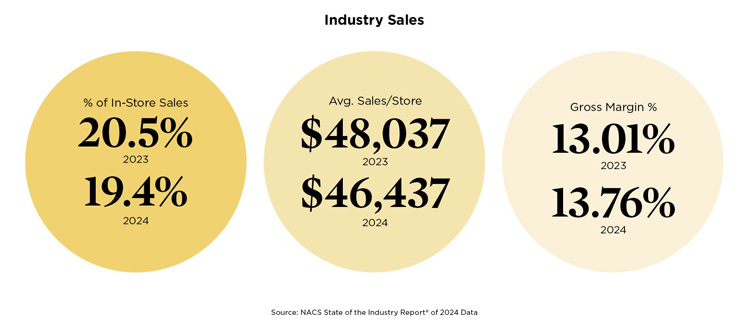
The NACS State of the Industry Report® of 2024 Data showed cigarette sales down 3.33% and gross profits up 2.22%, driven mostly by price increases. The category contributed 19.4% of in-store sales and 7.1% of in-store gross profits.
Segment-level performance tells a more detailed story. Only subgeneric/private label and fourth-tier cigarettes grew both sales and margins. Subgeneric/private label rose 2.72% in sales and 12.8% in gross profit, while fourth tier surged 10.85% in sales and 20.45% in profits. Premium, branded discount and imports all declined.
This shift toward lower-priced options has been underway since the pandemic and likely will show up in 2025 year-end data. NACS data indicates only fourth tier and imports have grown so far this year.
“Economic pressures have accelerated consumer movement toward value-priced options,” said David Brinkley, vice president of sales at Cheyenne International. “The cigarette category continues to decline, but our position in the value segment has allowed us to outperform the industry.”
Consumer sentiment seems to be driving this trend more than official economic metrics have.
“While on paper the economy is kind of doing OK, the consumer sentiment is not quite matching up with that,” Tainter said. This has led to the trend of downtrading. “You might not give up your cigarettes, but maybe you can go down to the lower-priced option.”
The result has been a reevaluation of backbar strategies by both retailers and manufacturers.
Altria, for example, has expanded its Basic brand into 30,000 targeted stores. Company spokesperson Davien Anderson said, “We’ve seen an impact due to inflation outpacing wage growth. This has driven increased interest in value-tier products.”
Manufacturers are also adjusting how they approach pricing ladders and promotional programs.
“More recently, that [lower-tier] growth has begun to stabilize as manufacturers refine their product offerings, pricing strategies and retail programs, creating a more structured price ladder across the category,” said Matthew Domingo, senior director of external relations at Reynolds American Inc.
Retailers confirm the trend is consistent across multiple categories.
“We’re seeing a decline on premium—as is everyone else—and an increase in lower-priced options,” Bettencourt said. “But it’s not just in the cigarette category. You’re seeing it in a lot of other categories as well.”
OTP’s Rising Role
Even with shifts toward value options, the biggest pressure on cigarettes may be the growth of other tobacco products (OTP).
Subgeneric, fourth tier and imports remain small slices of the category. Together, they made up only 8.5% of cigarette sales in 2024, or about $4,000 per store, per month. Premium cigarettes alone represented 78.4% of the market, generating more than $36,000 in monthly sales per store.
OTP tells a different tale. “I think part of this story has to do with OTP,” Tainter said. “‘Poly-usage’ is the biggest trend that we’ve been talking about whenever we present on cigarettes and OTP.”
While three cigarette segments together generated just $4,000 in monthly sales in 2024, three OTP segments exceeded that individually. Other tobacco (including modern oral) averaged $6,388 per month, smokeless brought in $6,129 and e-cigs $4,309. Cigars added another $2,256 per month—more than subgeneric, fourth tier or imports individually.
Retailers and manufacturers are seeing that demand firsthand.
“I would say it absolutely is [growing],” Bettencourt said of OTP in her stores.
“We’re seeing growth in alternative products, particularly vapor and nicotine pouches,” Domingo said. “This shift underscores how adult nicotine consumers are increasingly seeking products that better align with their evolving preferences and lifestyles.”
Anderson emphasized the profitability angle. “The oral tobacco category is a key driver of profitability,” he said, citing double-digit growth for Altria’s On! brand in second-quarter 2025. “These results reinforce our commitment to offering adult consumers a range of alternatives beyond traditional cigarettes.”
Cigarettes still dwarf OTP in total sales. In 2024, cigarettes averaged $46,437 per store, per month, compared to $19,663 for OTP. But profit metrics are closer.
“The big story with OTP and cigarettes is the gross profit,” Tainter said. “When you look at the sales of cigarettes, what’s driving those high sales dollars are high unit sales volumes. When you look at the gross profit margin, it’s about 13%. But if you look at the margins of OTP, it’s pushing 30%. They’re evening out with the gross profit dollars.”
In 2024, OTP generated $5,801 in monthly per store gross profit, compared with cigarettes’ $6,389. That translated to 7.1% of total in-store gross profit for cigarettes and 6.3% for OTP.
Retailers have responded by reallocating space: shrinking premium -cigarette facings, expanding value-tier options and increasing room for OTP segments such as modern oral and vapor.
“You start to see a trend, and you follow it,” Bettencourt said. “I am adjusting the tobacco category the best I can, given the environment in which I operate.”
King or Not, Cigarettes Will Remain Key
Regardless of whether cigarettes hold onto the No. 1 sales spot in 2025, they remain deeply tied to the channel’s success. NielsenIQ data shows 82.1% of cigarettes sales in the United States last year happened in convenience stores.
“That’s a major trip driver,” Tainter of NACS said. “Cigarettes are why a certain percentage of people walk into a convenience store.”
That customer remains valuable, even as they shift down the price ladder or reduce purchase frequency.
“The cigarette customer is still a very important customer to us because they’re purchasing another item from behind the counter or something else in the store,” Bettencourt of Yatco said.
Manufacturers echo the importance of the channel.
“The convenience channel is foundational to our cigarette business,” Brinkley of Cheyenne said. “This channel enables us to showcase competitive pricing, maintain strong shelf visibility and provide retailers with affordable, high-turn products.”
For retailers, the challenge is less about growth and more about managing decline.
“Many moons ago, everybody wanted to be ahead of their competition,” Bettencourt said. “I guess the new version of being ahead of your competition is declining less than your competition.”