Because it can sell beer and wine for on-site consumption—and has access to gaming licenses—Rutter’s is finding that one important future path may very well be in the operation of full-fledged bars.
“As we worked on our next-generation prototypes, we thought, ‘We have great food; we can sell alcohol for on-premises consumption; we have gaming. They all go together, and we can make it more convenient than anyone else. Why shouldn’t we do a bar?’” said Chris Hartman, vice president of fuels, marketing and development for the York, Pennsylvania-based company. “We saw the opportunity for dwell time, a time for customers to be with friends, family or alone, depending on their situation.”
With those insights, Rutter’s opened its 1747 Bar & Lounge concept last year. It’s already four units strong, with more on the way.
Rutter’s isn’t the only c-store operator that sees opportunity in the hospitality business. Established retailers in markets around the country are also testing the waters. The ability to offer customers drinks to consume on site helps “to create an experience and to differentiate your store from other c-stores,” said Austin Burns, president and CEO of Paragon Solutions, a c-store design firm that worked with Rutter’s on 1747. “This industry is focused on getting in and getting out,” Burns said. “Now we’re saying, ‘Stay awhile.’ The longer you stay, the more you buy.”
Add-on and impulse sales are one of several benefits of a c-store model with alcoholic-beverage service. According to Joseph Bickham, CEO and owner of Dallas-based Fuel City, where four of the retailer’s seven locations serve up wine-based daiquiris and beer for on-site consumption, “We’re able to sell customers other merchandise from the store,” such as fresh-baked desserts, thereby leading to higher-ring baskets.Bickham and Hartman said the licensed beverage service is also helping their stores build dinnertime and evening traffic. “At Fuel City, we try to be an extraordinary business in an ordinary industry,” Bickham said. The ability to serve hard drinks “gives us the opportunity to drive the third daypart, the evening, when you don’t anticipate customers coming into a convenience store and dwelling for dinner.”
Surprising and Delighting
In some cases, c-store bars are so unexpected that customers do a double take when discovering them. The Little Shop in New York City was conceived as a c-store. But with 1,200 square feet, “We quickly realized we had a lot of space and decided to add a bar area,” said co-owner Anna Bazhenova. Opened in 2019 with a c-store in the front and a speakeasy-type bar in the back, the Little Shop has been a welcome addition to its South Street Seaport neighborhood.
“There was no general store in the area, so the community was very receptive,” said Bazhenova, a former advertising industry executive with no retail or restaurant experience prior to opening the Little Shop. “From tampons to Milky Ways, we carry it all.”
As for the bar, “it’s not a rowdy bar,” she said, and neighbors appreciate that the business is locally owned and its principals are active in the community. Among the bespoke cocktails offered are the tequila-based Chilled Espresso and the gin-forward Purple Vesper, both $19. For guests interested in a snack, “We encourage them to shop the shop,” Bazhenova said, and the items—including the likes of cheese and charcuterie—are then plated and served.
Another c-store/speakeasy hybrid was unveiled in Lakeville, Minnesota, last year when The Wondrous Collective—a group of various restaurant concepts—added the Farmer’s Cellar speakeasy to its Farmer’s Grandson Eatery c-store. Recently featured in the NACS Ideas 2 Go video series, the Farmer’s Cellar is hidden behind an imposter cooler door, requiring visitors—much like speakeasy patrons 100 years ago—to seek and discover the cocktail bar.
“We’re having a blast with it and people are having fun discovering it,” owner Tony Donatell said on a recent episode of the NACS Convenience Matters podcast. The Farmer’s Cellar is gaining recognition for its drinks program, which features inventive cocktails mixed up by professional bartenders, said Donatell. He decided to add the speakeasy to the c-store due to his success with alcoholic beverages at other concepts and because there weren’t any cocktail bars in the area. A cigar program may be added to complement the bar, he said.
David Barker, owner of Blowing Rock Market in Blowing Rock, North Carolina, credits the pandemic for transforming his once-traditional c-store into a haven where guests can sit near fire pits on the store’s patio with a glass of wine in hand and marvel at the surrounding mountain vista.
“When the pandemic hit and we were considered an essential business, it dawned on me that because we had outdoor seating on our patio, we could safely accommodate 100 people,” Barker said. “From 2020 to 2022, we had more business than we could handle.” The operation morphed so much into an on-premises venue that he “pulled the pumps off the property, and we’ve gone in another direction,” he said. In addition to a wide selection of wines available for purchase by the bottle or glass, Blowing Rock Market features a vast offering of local craft brews.
A Multi-Unit Opportunity
Rutter’s, meanwhile, is out to prove that a chain of c-stores with bars is possible. For about a decade, Rutter’s had been able to sell beer and wine for on- and off-premises consumption at its Pennsylvania stores thanks to its restaurant (or “R”) licenses. The company put those licenses to good use last April with the opening of the first 1747—an 11,000-square-foot store, with 500-600 square feet dedicated to the bar—in Johnstown, Pennsylvania. The second 1747 location in the state, in Milton, opened in May. In the fall, the concept was expanded to Winchester, Virginia, followed by a fourth location in Berkeley Springs, West Virginia. (Only the Pennsylvania venues offer gaming.) Three more units are planned to open this year, with more likely to come, Hartman said.
.jpg?language=en-US "bars_Rutters1-(1)")
“It’s a unique concept, and we’re retraining customers on what a convenience store is,” Hartman said of 1747, named for the year the company was founded. “We’ve done this already with foodservice. Now, with 1747, Rutter’s is considered a place to go to hang out at, not just for convenience items.”
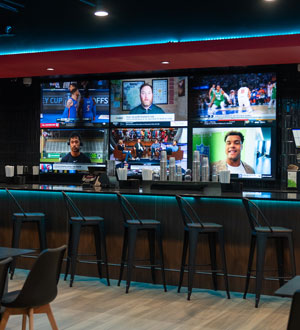
The Pennsylvania and Virginia 1747 locations serve beer, wine and canned cocktails, while the West Virginia store is licensed to sell full-strength cocktails, dispensed via a “smart bar” that doesn’t require a trained bartender, Hartman said. “We did a full ground-up revision to our c-store design,” Hartman said of the 1747 prototype, with the bar, for example, in the rear of the store, close to the foodservice area, with table and gaming seating nearby. Numerous large-screen TVs for sports viewing adorn the walls.
So far, customer response has been “very positive,” Hartman said. “Our plans are to keep growing the concept and to continually evaluate and adjust to make sure we’re providing the customer with the experience that they want just as we do elsewhere in the store.”
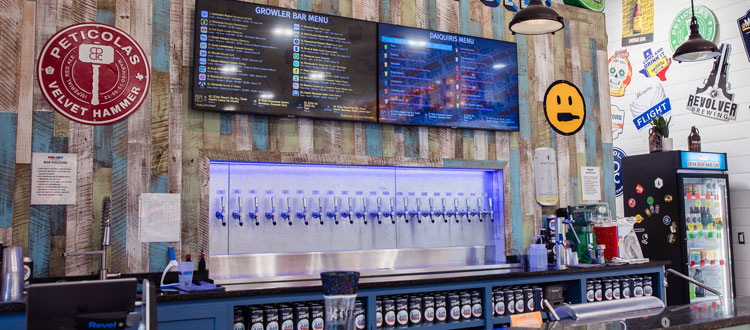
Fuel City’s Wylie, Texas, store features a bar that, in addition to the daiquiris, serves up 20 draft brews from large and small brewers alike. Pours range in size from 16 ounces for on-site consumption to 64-ounce growlers to go. A digital menu board provides descriptions of the offerings. At the other three Fuel City locations that allow on-premise consumption, canned and bottled beer is featured, along with eight or nine flavors of daiquiris served from a dispensed beverage machine.
“We fully wanted to incorporate our dining room around the drinks offerings, including the availability of local small-batch beers,” Bickham said of the Wylie store, which opened in 2022.
Date Night, With a Twist
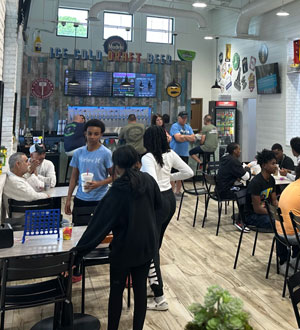
Customers are generally delighted to discover the ability to consume alcoholic drinks in c-stores, retailers say. “We’ve had quite a few daytime shoppers who’ve been coming in for a year and didn’t even know we had the bar, so they’ve been happily surprised,” said Bazhenova. “Some guys will even bring a date, and you can see the disappointment change to delight when they see the bar in the back.” The Little Shop also attracts repeat customers. “Because we have a reservation system, it’s not unusual to find someone who’s made 43 reservations,” she said.
Promotional support builds awareness of the venues and encourages visits. Carla Esparza, food and beverage director at Fuel City, said locations with on-site alcoholic beverage licenses promote events such as National Daiquiri Day with special pricing, while the Wylie store gets behind draft-beer-related celebrations, such as National Stout Day and National IPA Day.
Rutter’s has begun partnering with beverage suppliers on tie-ins to large sporting events to “maximize exposure” of 1747, Hartman said. Last summer, for example, the Johnstown location partnered with Monster Beverage Corp. for a UFC Fight Night watch party, which featured tastings of Monster alcoholic and non-alcoholic beverages.
Despite the Little Shop co-owner’s background in advertising, all marketing support is via word of mouth. “One thing I learned in my previous business is that to attract customers, you have to have an interesting product,” Bazhenova said.
Extra Responsibility
While c-store bars may spark curiosity and intrigue, challenges with the model can arise. Bazhenova and Hartman pointed to the need to hire and train the right staff for the operations.
“Even though everything is under one roof, we employ two different types of staff with two different kinds of skill sets,” Bazhenova said. Inventory management can also be a concern. “We need to stock two different kinds of inventory, with 3,000 SKUs in the front. While in the back, we’re creating products.”
Barker and Bickham agreed that an on-premises license to sell alcohol requires a heightened awareness of responsible service. With draft beer served at Fuel City’s Wylie store, it’s critical to monitor the quality of the product, Bickham said.
Burns of Paragon Solutions advises c-store operators considering expanding into on-premises licensed beverage service to consider recent trends in beer, wine and spirits. “Consumers are more health-conscious today,” he said. Whether the addition of a bar is part of a store expansion or a new build, “consider your brand,” he advised. “Understand the market. Understand the opportunity. Remember that you’re entering into a new business: the hospitality business.”
While the c-store/bar combination may not work at every Fuel City location due to space demands and legalities, Bickham said, “We’ll have an eye to incorporating the model at new locations because it’s been a good value-add.”
Rutter’s is equally bullish. “We’ve found that there’s a need from the customer, so it’s up to us to adapt and to continue to learn,” said Hartman. “We believe there’s a lot more room to run.”