Hemp beverages made quite the splash at the 2025 NACS Show, appearing in the Convenience Catalyst Showcase and dominating not just category discussions, but several Education Sessions and even General Sessions.
Diana Eberlein, chair of the Coalition for Adult Beverage Alternatives (CABA), pegged the hemp beverage market at nearly $1 billion in 2025, with the potential to hit $5 billion within a few years during the “Cracking Open the Potential of THC Beverages” Education Session.
“THC is the fastest-growing category in adult beverage,” she said.
Major retailers have taken note. Total Wine & More has long been in the THC beverage business. Circle K entered the space in 2025, followed by DoorDash. And during the week of the 2025 NACS Show, Target announced it was piloting the sale of THC beverages in 10 Minnesota stores.
Jason Zelinski, vice president of North American retail at NielsenIQ, predicted hemp beverages could easily reach 5%–7% of total U.S. alcohol sales within five years. “If we get federal runway?” he said during the “What’s Really in the Can? Selling Alcohol-Infused Products” Education Session. “The sky’s the limit.”
Or not.
Tucked more than 100 pages into the bill to reopen the government after the longest shutdown in U.S. history was a provision championed by Senator Mitch McConnell (R-Ky) to end what some have described as the “hemp loophole” from the 2018 Farm Bill, which descheduled hemp grown with less than 0.3% THC.
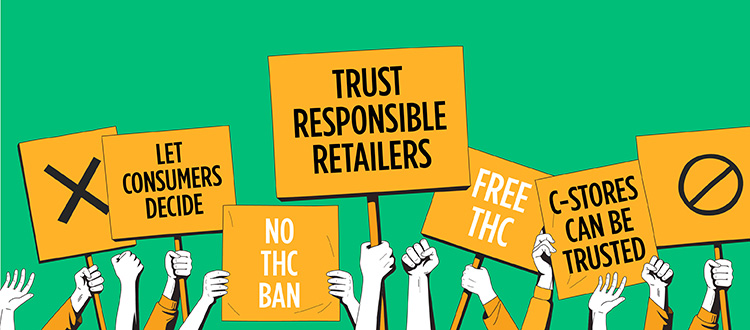
But all is not lost. Pamela Epstein, chief legal and regulatory officer for Nexus Agriscience, argues that hemp operators—and the retailers who sell their products—now have the opportunity to come together to not just advocate for an unregulated “loophole,” but for real, clear, responsible regulations.
“The intoxicating hemp market is at an inflection point,” she said. “We’re no longer talking about the poison, we’re talking about the dose.”
Here’s what convenience retailers should know about what did and didn’t happen in federal law, the case for regulation over prohibition and the important role convenience can play in preserving the hemp-THC market—especially for hemp beverages.
Where We Are and How We Got Here
The ban took many bystanders by surprise. Earlier this summer, McConnell had agreed to strip such language from the Senate appropriations language after facing pushback from Sen. Rand Paul (R-Ky). Though the ban wasn’t reintroduced to the Senate version of the spending bill until hours before the vote, it didn’t shock long-time hemp advocates like Eberlein.
“We knew how McConnell felt, and he’s been very vocal about that for years,” she said.
As have other lawmakers. Proposals to ban intoxicating hemp have surfaced repeatedly since the 2018 Farm Bill’s passage but have never gained enough support to pass.
The government shutdown provided the perfect storm.
“This language would not have passed in a normal standalone bill or normal appropriation process—they tried,” said Jake Bullock, co-founder and CEO of the beverage brand Cann. “It was only in the dark of night, attached to a bill to end the country’s longest government shutdown. People’s SNAP benefits, military payments … all of these other big issues were at stake.”
“Forcing this into a must pass bill to open the government obviously led to significant complications in facilitating real debate through our partners in congress,” added David Mukpo, CEO of Mac Brands (whose THC beverage portfolio includes Pamos, Buddi and Lolli Soda).
That lack of debate paved the way for what effectively amounts to a ban on intoxicating hemp. The new language defines any hemp-derived cannabinoid products containing more than 0.3% total THC—or other cannabinoids with “similar effects”—or more than 0.4 mg of total THC per container as federally illegal.
The 0.4 mg threshold won’t just eliminate intoxicating hemp products, it will also wipe out much of the non-intoxicating CBD market, since most CBD products contain trace amounts of THC.
“This removes over 95% of all products on the market,” Mukpo said.
The move has frustrated not just brands but also retailers and state regulators who have spent years building responsible markets that their consumers have come to rely on.
“Since 2022, Minnesota has built one of the most thoughtful, functional and consumer-focused regulatory frameworks in the country—and it’s working,” said Lonnie McQuirter, director of operations for the Minnesota-based 36 Lyn Refuel Station and chair of the NACS Legislative Committee. “Washington D.C. should not punish success simply because it arrived ahead of schedule.”
A Glimmer of Hope
Though the “Hemp THC Banned” headline grabbed national attention, the spending bill did include provisions the industry broadly supports.
First, it re-affirmed the legality of naturally occurring Delta-9 THC, while banning synthetically derived cannabinoids—compounds that are intoxicating but, unlike Delta-9 THC, are not found naturally in the hemp plant. Mukpo described these synthetic products as “the key risk factor” for many regulators and banning them “does have broad consensus” among hemp beverage stakeholders.
Second, Delta-9 THC was not completely banned—only restricted.
“For the first time, Congress has set an amount of THC that will be allowed in consumer products,” Epstein noted. “That’s a recognition. We wouldn’t put 0.4 milligrams of heroin in a product because that is a dangerous substance.”
While 0.4 mg is still far below reasonable use levels, many in the industry view it as a starting point. A chance to negotiate for a higher, more realistic dosage cap.
Most importantly: the ban is not immediate. The new hemp limits won’t take effect until November 12, 2026, giving industry stakeholders one year to fight for better regulations.
“The one-year implementation is a lifeline,” Eberlein said.
Or as Bullock put it, “This is not a ban—it’s a one-year shot clock to go get the rules that we’ve always wanted.”
A Mainstream Market at Stake
The hemp rules apply to all product forms—flower, vape, edibles and beverages—but beverages occupy a unique position. They’ve thrived specifically because they’re available in mainstream retail.
Bullock and Mukpo first launched their beverages in marijuana dispensaries. But the dispensary consumer proved very different from the low-dose THC beverage drinker.
“By and large, dispensary consumers are not looking for low-dose beverages,” Mukpo said, noting that beverages account for under 2% of dispensary sales, most of which are high-dose products.
The 2-10 mg beverages offered by brands like Cann and Mac Brands didn’t take off until the 2018 Farm Bill allowed sales outside dispensaries in outlets where consumers shop for alcohol, not cannabis. Since then, low-dose THC beverage sales have soared, posting triple-digit growth in 2025, according to NielsenIQ.
Minnesota, the first state to regulate low-dose hemp, illustrates the opportunity.
“Minnesota’s regulated hemp market has been opening the door for adults who might not have ever tried a cannabis product before,” said McQuirter, noting the state’s 5 mg-per-serving THC cap. “They deliver a mild experience for adults looking for a different experience than high-potency cannabis.”
“What’s amazing is taking that same product and watching it expand outside the dispensary channel has completely changed the face of what that consumer looks like,” Mukpo said. “Not because the product changed—it simply changed the consumer it was available to.”
Consumer data reinforces the category’s legitimacy. A 2025 survey by Bump Williams Consulting found:
- 80% of adult beverage consumers expect to replace alcohol with THC beverages on some occasions.
- 37.5% predicted they would decrease alcohol consumption.
- 46.5% expected to increase THC beverage use.
Even in states where hemp products can’t yet be sold at mainstream retail, retailers see the potential.
“Allowing the sale of responsibly regulated low-dose hemp products would help by giving retailers a lawful, in-demand alternative,” said Alessandra Magnasco, senior director of government affairs for the California Fuel and Convenience Alliance (CFCA). “This new product category would support small businesses, help stabilize store revenue and allow retailers to continue serving their communities while staying fully compliant with state law.”
What Happens When an Established Market Is Banned
No one in the industry disputes that some players exploited the “loophole.” But most agree those high-dose, synthetically produced, youth-targeted products—not the low-dose beverages sold in liquor, grocery and convenience stores—caused the knee-jerk policy reaction.
“We are in the situation we’re in because bad actors were selling these highly potent, highly intoxicating, synthetic products, marketed towards children,” Bullock said.
Of course, convenience retailers know all too well what happens when consumer demand collides with prohibition: Responsible players exit the market while bad actors thrive underground.
According to Lyle Beckwith, NACS senior vice president of government affairs, this pattern has played out repeatedly.
“The simplest way to look at it is microcosms of where there were flavored vape bans or menthol bans,” Beckwith said. “Those categories don’t go away—they just go to other, less law-abiding retailers.”
California provides a clear case study. A report from the Mackinac Center found that after the state’s 2022 menthol cigarette ban, California now leads the nation in cigarette smuggling. A 2023 WSPM Group study of discarded packs showed nearly the same percentage of menthol cigarette consumption post-ban as before—post ban, many were non-FDA-approved products trafficked by Mexican drug cartels.
“California retailers have seen firsthand how bans on previously legal products can fuel a thriving black market,” said Magnasco. “Even though retailers like CFCA members have followed the law and removed these products from their shelves, many have seen steep declines in tobacco sales because noncompliant sellers from the illicit market openly ignore the ban.”
The vapor category provides another warning. Flavored e-cigarettes and vaping products have technically been illegal without FDA approval (which has never been granted) since 2020—yet research from the Truth Initiative found that over 86% of e-cigarettes sold in 2025 were flavored and illegal.
Unlike previous tobacco regulations, the hemp provision appears to contain no federal enforcement plan.
“I have no idea what the enforcement plan is,” Beckwith said. “And given the fact that there has been no enforcement in the vape category to speak of, it certainly raises questions about how this will be enforced.”
That’s one reason NACS has committed to advocating for sensible low-dose hemp beverage rules, even on behalf of members who don’t currently sell these products.
“We are advocating for regulation rather than prohibition,” Beckwith said. “We know if there’s market demand, people will find it—and they’ll find it from people who don’t check IDs, who don’t pay taxes and who sell lots of other illegal things.”
What Comes Next: Building a Coalition
The pressure is on for those hoping for regulation instead of prohibition. Though the federal ban doesn’t take effect until November 2026, realistic timelines for rulemaking are much shorter. Retailers and wholesalers are unlikely to risk holding inventory that could suddenly become illegal.
“If rules are not passed in the next eight months, retailers could continue to sell until November—but they might not be able to get it if wholesalers stop carrying,” Bullock said.
Getting anything passed through Congress remains an uphill battle, but advocates agree on one thing: Success will require coalitions that extend beyond hemp.
“We need to bring on traditional businesses,” said Epstein of Nexus Agriscience.
Convenience could be a key ally. The channel’s size, credibility and long-standing relationships at both state and federal levels make it an essential voice.
“I think legislators will naturally give more weight to the trusted, long-established retailers who have spent decades in the alcohol industry, rather than to the newcomers in the fast-expanding hemp sector, which has yet to build comparable relationships at the capitol,” Mukpo said.
Shifting the narrative from “preserving a loophole” to “establishing regulation” has already made it easier for mainstream partners to join the conversation. Groups like CABA are pushing for a regulatory framework that mirrors alcohol’s—a familiar, proven model for responsible age-gated products.
“We want to show that we are looking to play in their sandbox and work within their infrastructure and to create a more even playing field,” said Eberlein, citing outreach to both alcohol retailers and manufacturers. “We need to make sure that it is abundantly clear what we see our pathway forward being, so that we can collaborate and come up with sensible regulation they can participate in.”
Flexibility will be key. Epstein cautions that proposals seeking to simply undo the hemp ban without dosage limits or state oversight “are not going to get to 60 votes.”
“It really is in the hands of the industry to figure out how to come together and ask for the low-dose channel that it so desperately needed and wanted,” she said.
Beckwith agreed, noting that like any negotiation, coalition-building must balance ideals with political realities.
“Our main goal from the NACS government relations perspective is to make sure that if these products are legal, convenience retailers can responsibly sell them,” he said.
With the early support of associations like NACS, the Wine and Spirit Wholesalers of America (WSWA) and others, hemp beverage advocates remain cautiously optimistic.
“This is not the conclusion,” Epstein said. “This is the opening of a conversation.”