Restrooms are not a glamorous subject to talk about, even less to write an entire article about, but they are essential elements of any convenience store.
“As a retailer, you are defined by your restroom,” said Austin Burns, president and CEO of design company Paragon Solutions, Fort Worth, Texas. The restroom, he said, is a profit center: It brings in customers who need to use it, and they then purchase items in the c-store. Restrooms are a great place for c-stores to say “We’ve thought about you” to customers, he added.
A well-maintained restroom also lends a positive image to the entire operation, which is especially important for convenience stores with a prepared foods program.
“A pleasant restroom has as much importance as how the pizza tastes,” said Alicia LaFollette, brand director of InConvenience Inc., which operates 20 Gas Spot stores in Missouri, Arkansas and Iowa.
“Study after study shows that restroom design (and maintenance) overwhelmingly impact not only loyalty but also recommendations and sales conversions,” said April Matthews, senior retail designer for King Retail Solutions, a design company based in Eugene, Oregon. “They can be a customer’s top factor in assessing the quality and safety of a store.”
A Focus on Clean
A survey done annually by Menomonee Falls, Wisconsin-based Bradley Co., a manufacturer of commercial plumbing fixtures and restroom accessories, sheds light on how dirty or unpleasant restrooms can reflect poorly on a c-store.
Bradley found the top complaints are about toilets that don’t flush or are clogged. Fans or air fresheners are important, as is maintaining a cleaning schedule.
“Washing your hands is supposed to be a clean, hygienic experience,” said Cassie Keeler, product manager of handwashing products at Bradley. Simply having a sign-off sheet in the restroom showing when it was last checked by an employee can give users peace of mind, she said.
InConvenience sets clear expectations about restroom maintenance with its store employees. “We drive home that this is one of the simplest things they can do,” said CEO Tiffany Fraley.
Dirty restrooms automatically translate as dirty food, “whether it’s true or not,” said Joseph Bona, executive director of retail design firm BDL Partners. Think about the restroom as an extension of the whole store, he said. “Consider it part of the store experience and provide the feeling that some thought went into it.”
Koch pointed out that there’s a rollover effect of this: Clean restrooms can lead to customers perceiving the store’s fuel as higher quality and also spending more in the store because they identify it as carrying better products.
Making sure restroom cleaning doesn’t slip under the radar, Sprint Mart, based in Ridgeland, Mississippi, has full-time restroom attendants at its new Fulton, Mississippi, store. Employees of each gender clean the restrooms so they don’t have to close them down for servicing, said Herb Hargraves, chief operating officer.
Fixtures: Automatic or Manual?
A big question facing convenience stores is to what extent restroom fixtures should be automated. Soap dispensers, faucets and dryers can all be activated with a simple hand gesture, but is this technology a good idea for convenience stores?
Keeler said customers are about evenly split on whether they prefer a hand dryer or paper towels. “So it’s best to have both,” she said. Hand dryers, she pointed out, may have a higher up-front cost, “but they’re pretty economical once they’re operating.” However, some customers don’t want to spend time drying their hands, or they like to use a paper towel to open the door.
The difficulty with paper towels, as operators know, is they often don’t make it into the garbage, or the restroom hasn’t been maintained and the waste receptacle is overflowing. Conversely, hand dryers can leave water dripping down the walls where consumers have shaken their hands. And the machines can break down.
Any c-store with paper towels in its restroom should place the trash can near the door—a simple move to help with neatness and to make life easier for consumers, Bona said.
To minimize water on the floor, place the paper towels as close to the sink as you can, Burns said.
Another automatic feature that can be very helpful, Bona said, is lighting. Having motion-triggered lighting saves energy and also shows customers that the brand is thinking about environmental issues.
Sprint Mart has mostly returned to manual fixtures in its restrooms because automatic products can be hard to maintain, and faucet and soap dispensers quickly run through batteries, which puts the onus on staff to replace them. Hand dryers do not have this issue, Hargraves said, because they use long-lasting lithium-ion batteries.
Materials Matter
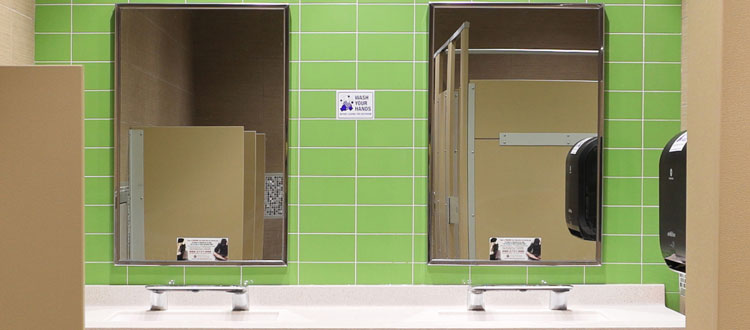
The materials designers use in convenience store restrooms should be attractive yet practical. Coordinated finishes let customers know the restroom was intended to look nice, Keeler said. This can be accentuated with framed mirrors—especially if the finish on the frame matches the soap dispensers—and mirrors with LED lighting, she said.
Tile is a popular product to use because it’s durable and easy to clean. Some restrooms use fire-resistant panels (FRPs), which are less expensive but also less durable.
InConvenience reports it found a great FRP product that looks like subway tile and has a dimensional quality to it. The company has lined Gas Spot restrooms with it, floor to ceiling, “and it gives the look of a very clean space,” LaFollette said. Also, it’s easy to clean and graffiti-proof, she said, adding that employees are more inclined to take care of a space if it looks nice.
The larger the tiles are, the better, Burns said, because there’s less grout, which can collect dirt. He prefers cabinet-style areas under sinks because they have fewer nooks and crannies that can hold dirt and dust. If you are considering European-style stalls, Burns advises that the stall doors should have a gap underneath for cleaning purposes.
The materials selected for a restroom can also influence the perception of cleanliness, including bright, even lighting, allowing for no dark corners or stalls. And restrooms with nicer materials can influence customers to clean up after themselves and make people less likely to vandalize, Matthews said.
Natural light through windows or skylights has been a big focus for EZ Stop. It “brings in a clean feel,” said Trenton Langston, vice president of Calloway Oil, Maryville, Tennessee, which operates the stores.
Langston also pays attention to lighting. “Light and fixtures are expressions of our identity and style,” he said. Renovated and new restrooms feature retro-style globe lights, which he said “is an overall Americana style.”
EZ Stop’s newer restrooms feature durable porcelain tiles on the floors that look like wood “to make it feel a bit warmer,” Langston said. The company has experimented with a couple of different colors, but the lighter wood “allows us to project more light throughout,” he said. The stores also use a lot of local reclaimed wood accents. This way, he said, “the warmth and the tones are carried throughout.”
EZ Stop pays a lot of attention to drain placement, which helps employees with mopping and helps reduce spilled water from customers, making the floors safer and more attractive.
Bona advises staying away from concrete floors, “which might look cool and hip but tend to be more porous and absorb stains and odors,” he said.
Branding Continuation
Restrooms shouldn’t be built as merely functional stops; they’re an opportunity for c-stores to continue their brand.
“Restrooms can be a branding statement,” Burns said. “You want to bring in the look and feel and color palette.” He likes to continue some of the tile from the front of the store through the restroom.
And don’t be afraid to have some fun. “Restrooms are a really great way to bring in the character of the brand,” he said. “If you have a whimsical, sassy type of brand, restrooms are a really good place to play with it. If you can differentiate, embrace the opportunity.”
However, Matthews said, customers typically don’t want a visually over-the-top restroom, so branding should be subtle. She suggested tying in louder brand colors as accents. “If there are neutral versions of your brand colors (less saturated, and darker or lighter), that can be a fantastic choice,” she said.
Sprint Mart features its signature blue brand color in its restrooms. In its new Fulton, Mississippi, store, it’s doing something new. It has a backlit sign that sticks out from the wall, indicating “Bestrooms,” which ties in with its taglines of “Run With the Best” and “Have the Best Day,” Hargraves said.
EZ Stop features penny tiles in its accent color of navy on the wall, about four feet off the floor. “[It’s] a nice way to bring in some branding and colors,” Langston said. Stall doors are red, incorporating another brand color.
Restrooms may not be anyone’s favorite subject to talk about, but putting thought and consideration into them can translate to happy customers who will keep coming back.
Extra Care
Having unnecessary but helpful items in a restroom “speaks to the brand and that they’re there to service customers,” said Joseph Bona, executive director of retail design firm BDL Partners.
Austin Burns, president and CEO of Paragon Solutions, adds, “These are the things that are going to make you stand out.”
Such items include but are not limited to:
- Baby changing stations
- Clothing hooks
- Step stools for children, or even a lower sink
- A chair or artwork, which can infuse a feeling of home and offers some comfort
- A janitorial closet nearby to make it super accessible for employees
- Free menstrual products