As Director of NACS Global, Mark Wohltmann has traveled the world and seen convenience stores in dozens of countries. If you ask him, the U.S. is leading the way in technology. It has the most tech implemented in the most number of stores. But there are countries that pull ahead in certain areas—the future of payments, for example, can be found in India, Wohltmann said.
“For every issue and opportunity that you’re working on, everything that you have on your agenda right now, there’s someone somewhere in the world who has already done it—someone who has already implemented it, already thought about it, already tried it, someone who is more advanced than you are. Learn from them,” said Wohltmann during a presentation at the 2026 Conexxus Annual Conference.
“What’s different now isn’t just the technology itself,” said Brian Gray, managing director at Accenture. “It’s the speed.” According to Gray, tech updates that took up to a year to design and deploy can now happen in a matter of weeks. An accelerating rate of change puts the focus squarely on the basics: Your people. “The retailers that will pull ahead are the ones investing in their people as much as their technology,” Gray said, “upskilling their teams while at the same time moving beyond pilots and scaling these capabilities across their network.”
Christian Warning founder and CEO of The Retail Marketeers and a member of the NACS Global Industry Engagement Council, and based in Hamburg, Germany, said technology is “the central lever for both driving sales growth and boosting margins, plus protecting margins on the cost side. You could view tech as a defensive strategy.”
The View From Germany
 Home to some of the most successful discount retail models in the world—Aldi and Lidl—Germany has “one of the tightest margins in retail. There are very price-conscious consumers here in Germany, and therefore retailers really consider their cost position before investing, even if it’s an interesting tech.”
European retailers are focused on technology that improves cost and efficiency, and have been implementing AI in operations to reduce waste and maximize labor hours.
“Some of the best examples of this are self-ordering terminals and self-checkout. These have two major impacts: The average basket is higher because people add on more when they’re anonymous and can customize their meal, and customers are also willing to spend more if they use cashless payment. What you’re really doing here is transferring operational processes to the consumer, which reallocates your labor to more effective places,” he said.
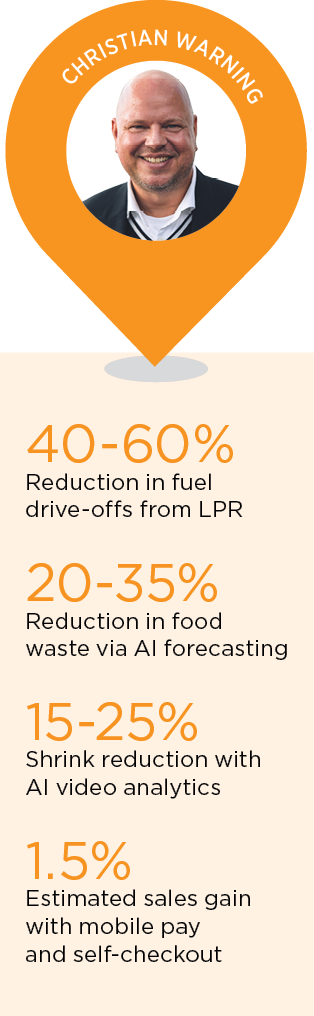
Warning said that based on his company’s research, implementing self-checkout can reduce dedicated cashier hours by 2–4%. Self-checkout and mobile pay reduce wait times, which prevents abandoned baskets and can lead to an estimated 0.5–1.5% sales gain.
“I think that’s the most powerful kind of tech use case, because it affects both sides of the P&L,” he said.
Retailers are also increasingly using AI for operations that improve cost and efficiency, such as food waste reduction through demand forecasting, which can reduce food waste by 20-35% according to Warning’s research; automated scheduling, task management, and replenishment systems that can reduce staff hours required for store operation by 5–10%; and loss prevention for both fuel and in store merchandise. License plate recognition and prepay for fuel cuts drive-offs by 40-60%, Warning said. “And AI video analytics integrated with inventory systems are proving effective at reducing shrink by 15-25%.”
AI models for predictive maintenance are widespread in Europe. From coffee machines and car washes to coolers and fuel pumps, “Everything has to be well connected and it has to be working. A dashboard can give retailers different escalation levels and alerts if machines might break,” he said.
Retailers in this region are using technology to unlock “new profit pools,” he said, specifically through loyalty and personalization, subscription models and retail media networks.
A key goal here is creating a frictionless experience for the consumer. Warning pointed to license plate recognition technology that’s popular in Nordic regions, where a system recognizes the vehicles of loyalty customers and can charge their account for fuel. “Car wash is also a really easy place to implement this and pair it with a subscription program. That has an immense margin and it creates the frictionless experience where you just go into the car wash and off you go.”
Warning is also seeing European retailers implement coffee subscriptions with loyalty apps. “That becomes a powerful marketing kit, because we all know that people are in a hurry. If you have them in your loyalty system and can get them to come in on a daily basis, that’s beneficial and the customer satisfaction index is higher.”
One advanced subscription use case Warning noted is from Respol, an energy company in Spain. If customers have the company’s other utilities at home, such as photovoltaic solar panels on their roof, they can get rewards or discounts which are redeemable for filling up cars at Respol gas stations. He said the company already has nearly 10 million users in Spain.
“By having the customer really locked into that system, they’re not driving to competitors to fill up. [Respol] is combining an old energy model with new convenience ideas, and bringing all of it together on a digital backbone.”
The View From Northern Europe
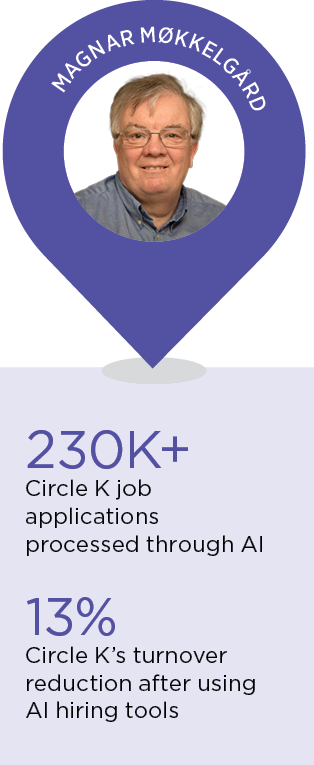 “So far, [AI] is all about making the back offices more efficient,” in the Nordic and Baltic countries, said Magnar Møkkelgård, former VP M&A, Reitan, and member of the NACS Global Industry Engagement Council.
Circle K, which operates stores in all Nordic and Baltic countries except Iceland and Finland, won the 2025 NACS Convenience Retail Technology Award Europe, where it was recognized for its AI-powered staff assessment and hiring system—one of the best examples of what Circle K is doing with AI, Møkkelgård said.
The hiring system used AI for candidate evaluations, processing over 230,000 applicants and reducing turnover by 13% at the time of the award.
For Reitan Convenience, with stores throughout the Nordic and Baltic countries, the AI journey began with employees using ChatGPT on their office computers. But its expanding its use of AI—exploring the technology in demand forecasting, security, compliance, staffing and in overall concept development. “When Reitan uses the word ‘concept,’ it encompasses a lot. Not just the store layout, but also the assortment, promotion spaces, customer flow, service—everything, really,” Møkkelgård said.
One Nordic grocery retailer is experimenting with a scan-and-go solution, where customers scan products with their phone, put them into the basket and just walk out. Customers in this region love to use self-checkout, but scan-and-go is not winning over customers, Møkkelgård noted.
“Trusting in technology—seeing that it really works—it’s difficult [for consumers]. I think that’s why we see that these solutions are not heavily used by the customers,” he said.
The View From Asia
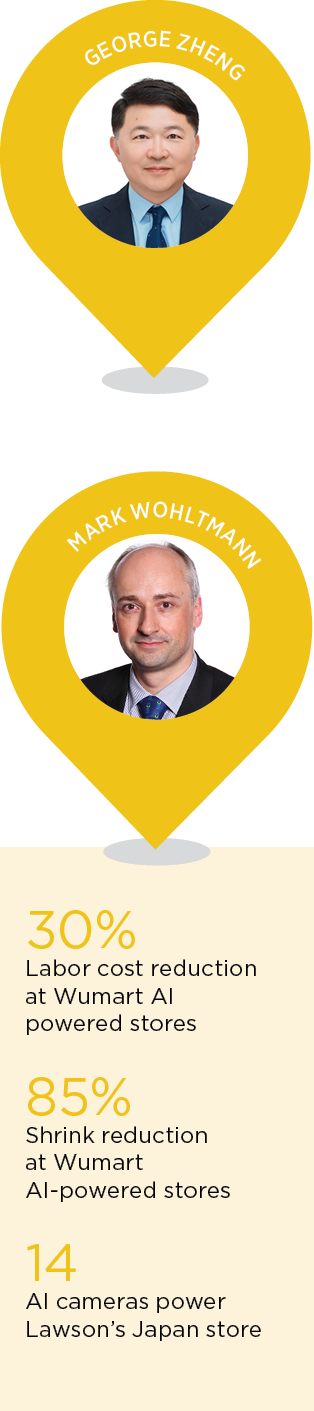 George Zheng, NACS Asia Pacific director, described AI use in China as both tangible and intangible. The tangible part: Improved versions of delivery robots or robots that can stock shelves. The real excitement, as in other countries, is the intangible use of AI. Zheng noted numerous cloud-based solutions that are being developed and implemented in the country, impacting everything from how to optimize expansion plans to customizing loyalty programs.
A tech leader is c-store operator Meiyijia, with over 35,000 locations across China and growing by over 4,000 sites each year. The company partnered with AI-solutions company Huawei Cloud to build an integrated operational network that connects all of its stores under a single platform. AI-based digital assistants can answer customer questions or help them purchase products. When needed, shop owners can even switch to an “unmanned mode,” where the digital assistant looks after the store.
“The AI can’t always read a customer’s emotions or what they mean, so sometimes it gives the wrong answers or will repeat the same sentence over and over,” Zheng said. Meiyijia noted that the accuracy for its digital store assistants is, in many cases, still around 70%, but that the accuracy is gradually increasing.
NACS’ Wohltmann also shared three exciting examples he’s seen recently of advanced tech that “makes stores more efficient, more effective, faster, and ensures [retailers] have all the necessary tools that they need.”
Unmanned stores: Unmanned stores in China have boomed in recent years. They rely on AI and camera technology to support an experience similar to the one at Amazon Go stores. Unmanned stores are great places to collect data, said Wohltmann. “You get all the information. How many people came in—who, when, where did they go? How long did it take them to walk to and from certain areas of the store? How long did they interact with a shelf? How long did they interact with a product? Which product did they take? You get so much data, but you also don’t even need an unmanned store for that. You can just take the technology and use it in your existing physical stores. It’s not about operating as many unmanned stores as possible. It’s about how you get more data,” he said.
Drone delivery: For years, China has been a leader in the “low-altitude” economy—manned and unmanned economic activities occurring in the airspace up to 1,000 meters above ground. Government policy has encouraged growth in this space.
“The fantastic thing here is that the restaurants extend their reach without any additional employees, without any additional infrastructure besides this little receiving box that is being operated by the delivery company,” said Wohltmann.
Zheng noted that the drone infrastructure is “still being developed,” highlighting that drones can take longer for delivery because there isn’t always a dedicated location for a drone to land, and that people in many cases still have to walk to pick up their food from the drone. Zheng anticipates that drone delivery will be most popular long-term in rural or mountainous areas and in emergency scenarios.
Smart sensors: Lawson introduced an AI-powered store in Japan last year, with plans to roll out the tech to other locations. Inside the store, 14 AI-powered cameras track items as customers pick them up and digital shelf displays make personalized product recommendations in real time—as a customer picks up a dessert, the AI recommends a hot coffee to go with it.
Chinese supermarket chain Wumart uses sensors from tech company Dmall to track and mitigate theft, make stores more efficient and increase profit, among other operations. In January 2026, Dmall said that by integrating its smart sensor tracking technology with Wumart’s POS data, inventory systems, in-store cameras and AIoT sensors in a 100-store pilot, the retailer saw a daily gross profit uplift of $421 per store, a 30% reduction in labor costs and an 85% decrease in shrink. Additionally, AI-driven energy management cut daily consumption by 26%.
“They measure and monitor everything. Every movement, every interaction,” said Wohltmann. “They can, in real time, analyze whatever is happening in the store. They know exactly how many people to send to which part of the store to restock shelves, to clean up or to help customers. They also have technology for self-scanning to detect fraud.” Sensors of this magnitude might be “a bit overkill” for the average convenience store, he said, but the technology has proven to have a positive impact on operations.
“By applying AI as an operating intelligence foundation, the partnership demonstrates how thousands of daily micro-decisions can be governed, coordinated and executed with consistency at scale,” said Dmall in a statement.
Accenture’s Angle
“It’s almost impossible to sit down with a c-level executive without AI coming up in the first few minutes of the conversation,” said Brian Gray, managing director, Accenture. And it’s not just talk. Retailers are investing real dollars—with the aim of returning real value. Gray’s seen a shift in the past year and a half away from a technology-as-innovation mindset and towards a paradigm where all tech investments have to drive incremental EBITDA.
He points to three essential drivers: Changing consumer expectations, as c-store customers increasingly expect the same level of tech they encounter at QSRs or other outlets; pressure on margins; and the need to adapt to operational complexity, including “matching the right talent with the right role.”
While the exact use cases of AI rapidly evolve, here are some areas where Gray reports that retailers are investing:
- Employee productivity
- AI camera and voice analytics
- Operational control centers (OCC): “Retailers globally are mobilizing operational control centers that provide real-time visibility across their network, with AI alerts to identify anomalies, performance issues and risks,” Gray said.
- Merchandising optimization
- Digital store operations: The goal here is to optimize labor through “better scheduling tools, leveraging sensors to automatically trigger tasks and maintenance alerts, using AI assistants to support store teams, and automating processes or transitioning them to shared services models to improve efficiency,” Gray said.
- IT software development
- Call center optimization
- Marketing and sales support: AI can unlock personalization.