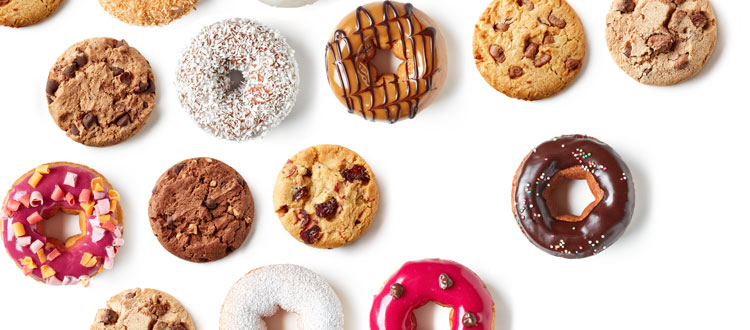
The approach each retailer takes to bakery becomes a key part of its identity—and approaches to a bakery program are as varied as the options in a bakery case.
At one extreme, Kwik Trip Inc. operates an advanced and well-respected vertically integrated bakery program, with dozens of products—doughnuts, cookies, cinnamon rolls, bagels, muffins and more—produced in its 245,000-square-foot Sweets Bakery in La Crosse, Wisconsin.
On the other end, almost all convenience retailers embrace some type of packaged-bakery presence, stocking and promoting cookies, doughnuts and other sweet snacks from well-known suppliers, such as Mondelez International, Famous Amos, Pepperidge Farms, Entenmann’s, Hostess and others.
A Hybrid Approach
Somewhere in between is a combination of these methods. A retailer may bake some products in-house, thaw and serve fresh-frozen products from suppliers and also highlight packaged products.
This is how Global Partners operates, with some variety, across its multiple c-store brands.
“Our programs vary. We have different value propositions for our banners,” said Jac Moskalik, vice president of food, innovation and strategy at Global Partners, Waltham, Massachusetts.
As its name suggests, the company’s Alltown Fresh stores are all about fresh food products.
“At Alltown Fresh, bakery is a cornerstone,” Moskalik said, “and we’re going to be going much bigger in 2026, as we are with our other banners, because I firmly believe that bakery provides a halo of ‘fresh’ when you walk in the store.”
To brighten that halo, muffins are baked fresh in Alltown Fresh stores, while the newly reimagined Honey Farms stores—another of Global Partners’ retail brands—merchandises cinnamon rolls fresh out of the oven. The latter’s new store design was introduced last spring in Raynham, Massachusetts.
“The cinnamon rolls, when they’re baking, you can smell them in the parking lot. And that was done by design,” Moskalik said. “There’s nothing better than when you’re walking into a store and get that smell. [As a retailer,] you want that aroma of fresh-baked bread or fresh-baked cookies, anything that makes somebody gravitate over to the bakery case because so much of our sales are impulse sales in that category.”
As a complement to baked-in-house products, Global Partners also stocks a variety of as-good-as-fresh thaw-and-serve varieties. This is where supplier Rich Products plays, offering thaw-and-serve options—cookies, muffins, doughnuts, brownies and more—or dough to be baked in stores. Rich’s also offers a turnkey solution that provides the merchandising, equipment and smallware that c-stores need for bakery programs.
“Fresh bakery items signal a commitment to quality and consistency,” said Elizabeth Sommer, customer marketing manager for Rich Products, Buffalo, New York. “This differentiation can be a powerful driver of repeat business and brand preference. Embracing a bakery program is more than just adding a new product category; it’s about creating a richer, more engaging retail experience that benefits both the customer and the bottom line.”
In particular, she said doughnut sales are predicted to grow 20% over the next four years.
Tasty Breads is yet another step removed from prepackaged bakery. It provides premade doughs—from cookies to pizza crust—that retailers finish in their in-store kitchens.
“We are mainly a private-label company,” said Marc Retondo, director of national accounts for Chicago-based Tasty Breads. “All you’ve got to do is pop [the dough] in the oven and you’ve got that aroma in your store, and nothing is better than that. That’s what sells bakery.”
Signature Style
Moskalik is currently working with a third-party vendor to create a signature doughnut for Alltown Fresh that stores can use as a calling card.
“It would be amazing to have a signature doughnut and other signature offerings,” she said. “It’s always hard to compete in bakery, so you have to test the boundaries.”
Kwik Trip knows a thing or two about signature doughnuts. In its Sweets Bakery, the retailer can crank out, per minute, 240 cookies, 630 cake doughnuts or 400 of its famous Glazer doughnuts, often praised for their soft and airy bite and melt-in-your mouth consistency. Kwik Trip stores sell about 47 million of the Glazer doughnuts each year.
But the bakery doesn’t rest on its laurels. To make sure the category and its promotions stay fresh, it keeps a separate research and development team busy with thinking up limited-time variations of the doughnut and its other bakery products.
“They’re creating limited-time offer products for us all the time,” said Jamie Gay, director of Kwik Trip’s Sweets Bakery. “With our Dunker line, we typically do two [LTOs] a year to last six months each. We’ve done a cherry. We’ve done raspberry, lemon, pink lemonade, banana, multiple different flavors.
“They are always working on ‘What’s the next thing?’ We have an LTO calendar, and if there are open slots, it’s our job to make sure that we get enough flavors out in front of the retail group so they can pick which one they want to come next. It’s similar with pretty much all the products
we make.”
Fresh Versus Packaged
Part of Moskalik’s approach of having some products baked in-house—whether from scratch or frozen dough—is about embracing theater in stores.
“Theater is when a chef comes out from behind a kitchen counter with a tray full of fresh-baked muffins,” she said. “He’s putting them in the bakery case. Customers may see us packaging fresh-baked cookies in the store. They know that we make them on site, and it makes the customer feel very good about that product; it’s trusted.”
Even if not everything is made from scratch, when looking at the food program overall, “the customer wants to know it was made there somehow.”
At the same time, Moskalik is also embracing packaged bakery products for Global Partners’ stores.
“Packaged sweet goods, there’s nothing wrong with that,” she said. “It’s just a totally different customer. You have to know who you want to talk to and why.”
Moskalik said Global Partners will “go big on packaged bakery” in 2026, stocking more two- to four-count packages to build basket size.
“We’re going after larger ticket rings within bakery,” she said. “For Honey Farms, we partnered with Commonwealth Kitchens out of Boston [to embrace more local brands]. They’re an incubator for new and emerging brands. We’re pretty excited about that. The local component will be fun.”
That matches the vibe Global Partners is going for in Honey Farms stores, a feeling of being at home in your community.
“Our four pillars are fresh, local, community, and hospitality, and we try to support that from a foodservice perspective,” Moskalik said. “We go with a more nostalgic approach because we’re trying to attract Gen Z. So we have a melts program, with soups and salads and fresh sides. And there are [made-to-order items] in there, too, to add theater to the experience. Then we have a much bigger variety in that store of grab-and-go.”
Such moves into more packaged sweet snacks fits the current direction taken by Tate’s Bake Shop. The packaged-cookie manufacturer recently began targeting c-stores as customers and is finding it requires some innovation.
“Our No. 1 item—our 7-ounce package—works well [in convenience stores]. But we are evolving as we enter this space,” said Karyn Bahls, head of sales for Tate’s, Southampton, New York. “So we’re working on different pack sizes.”
The company introduced 3.5-ounce, 1-ounce two-count and 1-ounce Tiny Tate’s packages to retailers during the NACS Show in October.
“We’re trying to drive that immediate consumption and make it more accessible to drive trial and find those items that work, and then expand that into the market,” Bahls said.
Keeping It Fresh
The short message from all those interviewed for this report was summed up by Sommers of Rich Products: “There is no one-size-fits-all approach [to bakery].”
“From a simple cookie display to a full-service pastry counter, the spectrum of possibilities allows for strategic customization,” she said. “At the most basic level, a bakery program might consist of prepackaged cookies or muffins—easy to stock, low-maintenance and ideal for stores just beginning to explore fresh food. These items require minimal labor and infrastructure, making them a smart entry point for operators looking to test demand without significant investment.”
Jeff Keune, a former retailer and current principal consultant for 4910 Consulting, said the opportunity only grows from there.
“If the stores have invested in ovens, I would recommend a simple platform that gets the product in frozen and bakes it off,” he said. “If the brand has a commissary, I suggest they look at adding bakery platforms to the commissary and structure it so that it complements the rest of the platform and can be delivered on the same schedule.”
This is what Keune did when he was chief marketing officer at Thorntons.
“Thorntons had taken over a bakery and converted it to an owned-bakery platform, and it was very successful,” he said. “New products were introduced, and there was also the opportunity to leverage that space to deliver more than just bakery.”
“Overall, a bakery program can be a wonderful business builder and be leveraged to grow check transactions,” he concluded. “There are many good options, and the [retail] brand should do what is right for their business.”
Chocolate Chip for the Win
Just getting started in bakery? The chocolate chip cookie may be the best place to start. Multiple consumer surveys confirm chocolate chip is the most popular cookie flavor by a wide margin.
In a July 2025 survey by bakery company Tiff’s Treats, 82% of respondents chose chocolate chip as their favorite cookie, as well as the most top of mind, the most recognizable by smell and taste, and the “most classic.”
“Chocolate chip rules the world!” exclaimed Marc Retondo of Tasty Breads during the NACS Show in October. “Four basics typically rule a retailers’ sales: chocolate chip, oatmeal raisin, a sugar cookie and a fourth that may vary by region. It might be a peanut butter cookie or a white chocolate macadamia, for example. From there, they start getting a little more exotic.”
Earning Bakery Stripes
Jamie Gay and Jac Moskalik both oversee bakery programs in their respective jobs, but the routes they took to those positions were very different.
Gay wasn’t focused on a role in food at all. In college, she studied to be an athletic trainer. While in school, she took a job at Kwik Trip in Wisconsin to make ends meet.
“I was summer help,” she said. “I started in the kitchens, and I worked there for 13 years, working my way up.”
The retailer’s training and leadership development programs led Gay in a completely different direction.
“I found my niche,” she said. “I [found that I] really, really like manufacturing. And by the time that I had graduated college, I was pretty sure that I wasn’t going to go into my field. So I stayed on [at KT] from there.”
Today, Gay holds the title of director of Sweets Bakery at Kwik Trip’s headquarters in La Crosse, Wisconsin.
Meanwhile, Moskalik long had her eye on a future in baking, beginning her career in the grocery channel and developing food and bakery programs for prominent retail suppliers before winding up in the convenience channel. Today, she is vice president of food, innovation and strategy at Global Partners LP.
“Bakery is one of my biggest passions, both personally and at work,” she said, confessing she bakes everyday and is particularly interested in cookie and cake decorating. “I prefer the baking style where there’s some sort of art.”
Why Vertically Integrate?
Having a vertically integrated bakery program gives a retailer several advantages, from being able to source their own ingredients to freedom of menu development and schedule control. For Jamie Gay of Kwik Trip, the No. 1 advantage is food safety.
“We have control of our product pretty much every step of the way,” she said. “When we make a product, we won’t sign it out until it hits a 24-hour hold. That way we can look at all of our paperwork. We can review anything that we may question, and everything is still in our control.”
And with its primary distribution center (a second one opened in November) right across the street from the Sweets Bakery, this hold time doesn’t delay delivery of the product to stores.
“If we want to, at any time, do further testing on a product before we send it out, we can tell them to put it on hold in their system [to give us time to take another look at it],” she said. “Food safety is paramount for us.”