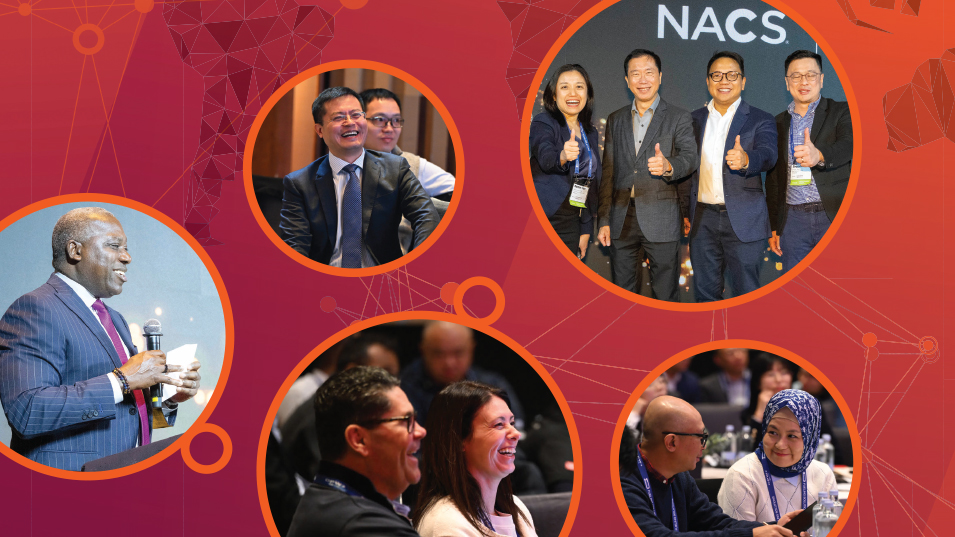
There was one word repeated during many of the 2026 NACS Convenience Summit Asia presentations: differentiation.
What makes your stores and your offer different? If that’s not clear, or the strategy isn’t fleshed out, are you stuck in a sea of sameness? Are you leveraging foodservice and your real estate? Are you keeping up with change?
We heard about these strategic issues and more in Shanghai from speakers and during conversations. Here are some of my takeaways.
Who Are Your Customers?
Whether you’re in the United States, Asia or Europe, people who belong to Generation Z (born 1997–2012) grew up with major world issues like global conflicts and a global pandemic. These experiences have shifted their shopping behavior. Because of this uncertainty and instability, their emotional needs, health and welfare are important to them.
C.F. Cheung of Ipsos got us thinking about why we should care about Gen Z. It’s not because they’re young; it’s because they’re a huge population that’s going to live a long time—and there are a lot of them.
And by the way, they have money. By 2034, Gen Z is predicted to reach about $9 trillion in global spending, which is more than any other generation. Cheung said that Gen Z is the first generation ever to reach two billion people, or more than a quarter of the total global population.
We also heard from Lynn Wang, executive director, NielsenIQ China, on trends and opportunities for retailers specifically in China, although the consumer insights are applicable within other regions.
She talked about channel reinvention and moving beyond just selling products—the sea of sameness— and redefining the convenience proposition.
Proximity, long hours of operation, the availability of late-night bites, supporting their health and wellness—these are all ways to meet the daily lifestyle needs of our customers and make convenience more about the overall experience than the price of goods.
Allen Zhang of BCG shared insights on our customers’ digital journey, which comes down to the touchpoints we create before they visit our sites, while they’re shopping the store, while they’re completing their transaction and after they leave. The question is no longer whether digital matters, he said, it’s how to create value across the entire customer journey.
Loyalty used to be what differentiated our channel from competitors, but now it’s table stakes. For example, personalization has become “a visit-deciding factor.” Rewards and product recommendations need to be unique to the customer and match their individual preferences, purchasing habits and personal milestones. And they want flexibility on how they use rewards.
Growing Foodservice by Taking QSR Business
The convenience channel is not going to grow foodservice by stealing share from other convenience stores down the street. We have to take business from QSRs, and that’s what Tom Kilroy, senior partner at McKinsey, talked about.
He mentioned several QSR trends that stood out to me:
- Value: Innovating with value products and bundles
- Digital: Leveraging data to drive insights and operational efficiencies; implementing AI for ordering and customer experiences
- Last mile: Investments in drive-thru, delivery and carry-out; mobile order and pay
Then he mentioned ways to compete with QSRs. Again, value and digital, and he mentioned hero items—what are you famous for?—that can differentiate your brand.
Kilroy also listed beverages, which we know are the c-store channel’s strength. However, we’ve seen QSRs like McDonald’s and Chick-fil-A test beverage-only concepts. Convenience has the broadest selection of beverages in any retail channel. We need to continue owning our beverage expertise if we want to compete.
A Revolution in Delivery
I like this finding from NielsenIQ: 60% of consumers in China are willing to pay more for faster delivery, which is good news because delivery costs will have to shift to the consumer regardless of your region.
In China, there has been a huge shift in traditional delivery models towards autonomous solutions. Use cases extend beyond retail, and include furniture delivery, cold supply chain delivery, community services for the elderly, and more—the future of delivery is here.
Will Zhao’s presentation, “What the Last Mile of Your Supply Chain Could Look Like,” showed us that future, and not just in China.
Zhao’s company, Neolix, operates in 15 countries and supports last-mile and middle-mile delivery. Zhao shared a case study with Sinopec’s uSmile c-store brand, where Neolix’s autonomous delivery solution has enabled more precise deliveries on complex urban routes, as well as reductions in vehicle and energy costs.
One point on autonomous delivery that’s worth noting is that accidents happen. When a vehicle breaks down, what happens to that delivery? The Neolix team does two things: It rescues the vehicle and makes sure that the delivery is made.
Lessons in Leadership
I always bring our Convenience Retailer of the Year Award winner on stage for a conversation. This year Stephane Coum, CEO of Central Food Retail Group, joined me, and he shared that a leader needs to bring a dream to his or her team. Other people may say, “paint the vision,” but there’s an emotional piece attached to building a dream.
I like that he said great leaders love their people. The most successful companies have leaders who are very people-driven, and they build their teams the same way. It’s one of the wonderful things about our industry—we’re a people industry that has more face-to-face interactions every day than any other channel.
He said you have to assemble a team of determined and passionate people. That doesn’t necessarily mean they’re the smartest people in the room, but they are the ones who can make the dream reality.
We talked about the future of our industry. Coum said online will continue to grow, and because of that, we have to keep innovating the physical store. C-stores have to be exciting and deliver something new and enticing. Again, how do you differentiate?
Then he mentioned that trust is irreplaceable and that revenue is not. This is important because we’re all in the business of selling things while also building our organizations. We do this with our people.
It’s easy to lead when things are easy, when the sun’s shining, right? Leadership really comes forth when times are tough, and that’s when we have to bring people together.
AI Is Not the Future—It’s the Present
Zhongwei “David” Ren of Dmall talked us through how digital intelligence brings retail back to its essence: “better, cheaper, faster.”
If there’s one thing that I’ve seen over the last two decades, and particularly in Asia, it’s technologists coming up with technologies that are bright and shiny and then looking for a retail application. Inevitably, the success rate is very low. If retailers start with the problem they’re trying to solve and then look for technologies to solve the problem, the success rates are much higher.
Ren talked about digital solutions making everything more efficient in retail and process changes. With the demands and complexities we all face in our operations, he suggested that we’ve essentially outpaced the limits of human management—and we need help.
Merchandising, product assortment, loss prevention, dynamic pricing— these are all areas that technology and AI can solve for. I always learn a lot from Brian Gray and the work he does at Accenture. From early AI adoption to generative AI to where we are today, it’s all about AI agents, use cases and implementation.
I like what Gray said about shifting from “human in the loop” to “human in the lead.” We need to stop thinking about AI in terms of a replacement—it’s a collaborator and another tool in our toolbox. This is similar to what Ren of Dmall said, that AI is not about replacing individual roles—it’s about upgrading the entire retail operating system with the tools and efficiencies that AI applications bring to our stores.
Retailer Case Studies
Two convenience retailers offered insights into their operations: Easy Joy by Sinopec and FamilyMart China.
Li Hong shared how Sinopec—an energy company—is innovating the Easy Joy gas station/c-store model while leveraging its core business. The shift is from a one-stop shop for fuel purchasing to a more serviceoriented ecosystem.
He shared great insights on leveraging real estate to get the highest and best use of sites. The company tore down a low-volume gasoline station and built a McDonald's in its place, and in another case, converted the second story of a store into a distribution center for nearby deliveries.
Haibin Wu of FamilyMart China talked about the retailer’s customers and the “silver tsunami,” where the amount of elderly people aged 60 and above in China has exceeded 310 million and accounts for 23% of the total population.
He brought up the idea of “thickening your relationship” with your customer, as in differentiating the store from an efficient space to make a quick purchase to a dwelling space. This is all about connecting with people. He shared examples of how FamilyMart’s physical stores have evolved, adding elements that promote lingering and browsing.