Many small convenience store operators, with a single location or a small chain, are looking to get into prepared foods.
“Everybody knows foodservice is the next revenue stream,” said Matt Chappell, corporate executive chef at Leo’s Market and Eatery in Greenfield, Indiana. The thing they’re wondering, he says, is “how do I capitalize on this idea?”
A solid foodservice program can be established and profitable with very few pieces of equipment, if they’re chosen carefully. But before operators consider equipment, they need to know what they’ll be serving.
“We like them to know their menu first,” said Jason Steiner, design sales consultant at C&T Design & Equipment Co., a broadline foodservice equipment dealer in Indianapolis, Indiana. “We also need to know how that food product’s being produced—from scratch or frozen, does it need to be held, are there assembly components or serving-line components. Menu drives everything.”
“We always start with the menu,” says Michelle Fronsee, senior vice president of retail business development for equipment manufacturer Middleby. “We need to understand what you want to make and what you want to serve.” Secondly, she looks at how much space a c-store operator has, to understand how much she can fit in.
The most popular prepared foods in convenience stores are handheld items like sandwiches and wraps, which are offered by 88% of operators, according to Technomic’s 2025 C-store Food Multi-Client Study. The report shows that 83% of operators offer breakfast foods and 71% serve pizza.
Within made-to-order food, pizza is most popular, offered by 67% of operators, followed by chicken sandwiches (54% of operators) and hot dogs (51% of operators).
Merrychef, a high-speed oven manufacturer, maintains a large database of “Ready Recipes” that have been designed to work with its equipment. “We work with chefs and culinarians around the world,” said Garamy Whitmore, general manager of Merrychef USA. “It’s a great resource for people to get new menu ideas.”
Multifunctional Equipment
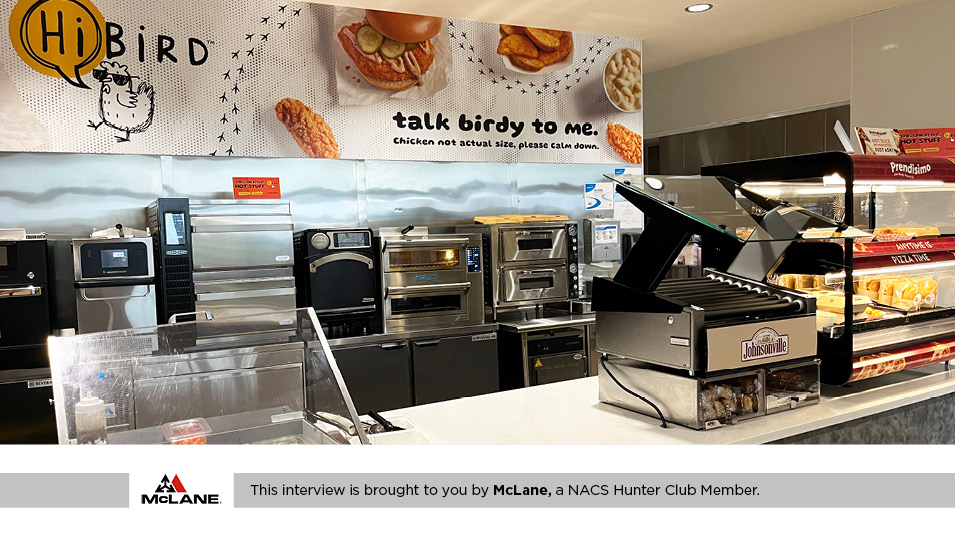
Today’s equipment tends to be multifunctional. Most manufacturers, Steiner said, offer speed ovens or combi ovens. The latter allow operators to roast, steam, bake, broil, retherm and poach foods; some speed ovens are divided, allowing different items to cook at different temperatures at the same time.
Operators “can produce a lot of menu items in a small footprint,” said Steiner. On top of that, these are very simple products to use; they can be programmed with the different food items a convenience store offers, then all an employee needs to do is press the button to heat or cook that item. “It’s one of those set-it-and-forget-it pieces,” Steiner explained.
Combination ovens are versatile by design. “It’s like a Swiss Army knife,” said Merrychef’s Whitmore. A single tool with a large number of applications allows operators to be flexible with their menus, offering different items throughout the day or between seasons.
“Today you might be baking pizza or air frying chicken, but tomorrow could be toasted wraps and next week could be protein bowls,” said Whitmore.
At Breez-In, a chain of four convenience stores headquartered in Prince George, Virginia, foodservice makes up 25% to 30% of the company’s business, excluding fuel. The stores used to have traditional ranges and ovens but switched to combi ovens for versatility five years ago. The combi, said COO David M. Bogese, “reduces the amount of guesswork you have to do.”
Leo’s Market and Eatery is known for its kolaches, which it previously cooked on-site in each store in double-stacked combi ovens. These ovens are “a versatile piece of equipment with a lot of different functions, because space-saving is always important,” said Chappell. “They were expensive, but it really saved money because we didn’t need a steamer or a smoker and we’ve never had a fryer.”
Leo’s has now expanded to seven locations, and the retailer decided it would be a better strategy to have an 8,000-square-foot commissary—which also has double-stack combi ovens.
Alto-Shaam, a Wisconsin-based foodservice equipment company, offers two bundles to small operators getting started with prepared foods.
For those who are primarily bringing in prepared foods, there’s a cook-and-hold oven and a hot food merchandiser; for operators cooking their own food, the other bundle features a multicook oven that can be programmed so items are cooked at the touch of a button, and a hot food merchandiser. “Those two pieces can be the foundation for whatever small operators want to do,” said Ben Leingang, senior director of national accounts.
Always Popular: Pizza
CD’s Quik Mart in Hopkins, Michigan, sells around 60 pizzas by the slice every day, as well as subs and salads. Co-owner Chris Kerber needs very little equipment for the pizzas, but one of the most important pieces is a tabletop dough sheeter that costs around $4,000. This flattens dough balls—which Kerber buys frozen—to a consistent thickness, so they’re ready to be topped. The store used to roll each one by hand.
Kerber also has a meat slicer and says his meat “looks better, tastes better” and that the slicer “helps with portion control, because we can control the thickness,” he said.
Finally, offering pizza requires an oven. At CD’s Quik Mart, that’s a six-foot-long conveyor oven that can cook a pizza in just over five minutes. “We are pretty much cooking pizzas all day,” said Kerber.
This past winter, CD’s Quik Mart started offering breakfast pizzas because the store is busy early morning and Kerber received a lot of requests. “We sell them by the slice ($3 to $3.50), but within the first week, people started ordering the whole thing,” said Kerber.
Vollrath also offers a conveyor sandwich oven for convenience stores wanting to offer hot food. It’s a horizontal pass-through oven that can be set at different temperatures for anything from pizza to sandwiches, melting cheese and warming foods.
Into the Fryer
Fried foods, especially chicken, are a perpetual c-store favorite. But fryers usually need a hood installed over them to transport grease and odors out of the building, and hoods are expensive.
There are ways to circumvent installing a hood if a convenience store can properly manage odors and heat produced through ventless equipment or a ventless hood system. Typically, ventless equipment uses a filter or a catalytic converter to eliminate grease and odors, Steiner said.
“Hoods are recommended if you can put them in because they get the grease-laden air out of the kitchen,” says Steiner. “But sometimes we can’t make that work, so we use ventless equipment.”
Leo’s Market and Eatery “has taken the time to understand that putting a hood in there, even though they don’t necessarily need one, holds out the bad air and brings in the good air,” says Steiner.
Most Breez-In stores have two fryers, one of which is an open fryer and the other a pressure fryer. The latter is used for poultry products to keep them moist, said Bogese.
“If you’re seriously frying food, we recommend exterior-vented hooded systems,” Steiner said. The ventless hoods need to be cleaned out regularly, “and that becomes a fairly expensive endeavor because the filter systems aren’t cheap and have to be replaced based on usage—and that could be monthly, quarterly, semi-annually or annually,” he explained.
There are ventless countertop fryers that are suited to small batches of food (no more than three pounds), Steiner said. They can be an excellent way to offer some fried options. Operators need to ensure they clean the vents on these small fryers regularly to avoid odors and malfunctions. These can also add significantly to the heat in a building, he added. He advised operators opting for these to regularly schedule visits from HVAC technicians to ensure there’s sufficient fresh air in the kitchen.
On Display
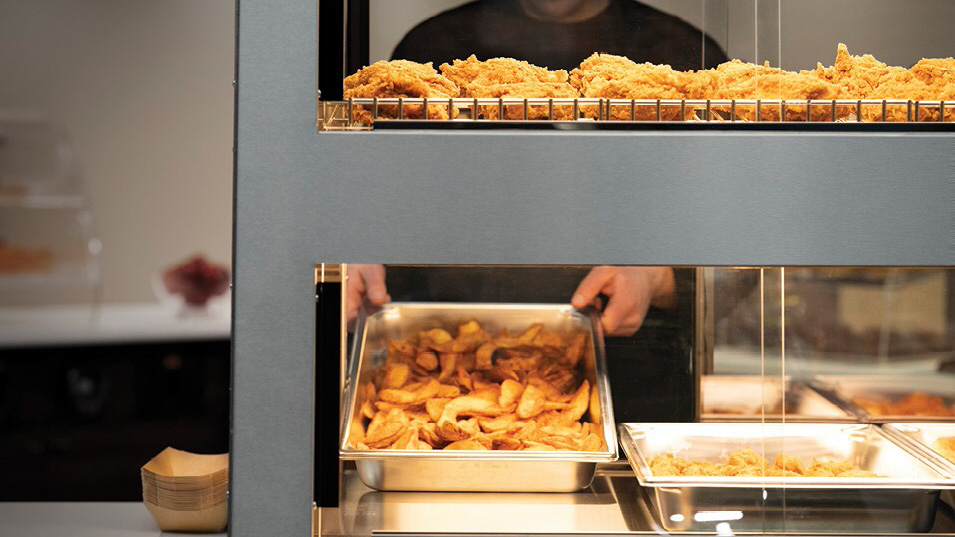
Stores offering hot foods for grab-and-go need a hot food display case, ideally one that’s humidity-controlled, which helps keep fried foods like chicken strips and potato wedges crispy for hours.
Vollrath recently launched a new case that comes in three configurations—one that holds up to three steamtable pans, one that holds up to four and a self-serve case without doors that doesn’t control the humidity quite as well but allows customers to take their own food, said Becky Guenter, product manager for countertop equipment. These cases also have different zones so food can be held in each one at a different temperature.
Breez-In stores all have six-foot-long holding cabinets, “which showcase what you’re offering, so you need a nice, appealing merchandising cabinet,” Bogese said. These feature breakfast biscuits and sliders early in the day, then transition to fried chicken and lunch/dinner items. Pizzas go in a specific self-serve pizza warmer.
Alto-Shaam’s hot food merchandisers help retailers keep food hot and maintain quality for long periods of time. They have heat on each shelf and heat that radiates from above, too, said Leingang, which also helps prevent condensation on the products. These come in countertop models for smaller operators and floor-standing models, with front doors, rear doors or both.
Hunt Brothers Pizza is one of several providers offering turnkey solutions to the industry. Dee Cleveland, director of marketing, offers advice from the perspective of the company: “The most effective merchandising is simple, consistent and easy for the consumer to understand in seconds.”
She offered three specifics:
1. Visibility.
“If consumers can’t see your food offering, they won’t consider it. Clear signage at the entrance, at the counter and near high-traffic areas is critical.”
2. Be disciplined in your messaging.
“One strong value message will outperform multiple competing messages,” said Cleveland. For Hunt Brothers, this means a focus on its “All Toppings No Extra Charge” offer. “It’s easy to understand and easy to remember.” Cleveland also emphasized the importance of consistency across locations: “Simple, repeatable merchandising wins over time.”
3. Connect the product to the moment.
“Use merchandising to highlight occasions, such as combination meal deals, lunch and dinner options,” said Cleveland.