This is part four of a five-part series that explores exclusive NACS consumer data. This month’s article dives into consumer perceptions of foodservice in convenience stores. Next month we conclude the series with a look at customer experience.
Foodservice in convenience stores has seen remarkable growth over the past two decades. In 2005, foodservice accounted for 11.9% of in-store sales. That percentage has more than doubled—foodservice accounted for 28.0% of in-store sales in 2025, according to numbers from the NACS State of the Industry Report®.
Looking back to 20 years ago, drug stores were seen as direct competition to c-stores, thanks to their expanding packaged food, beverage and merchandise selections. Today, with the growth of foodservice, quick-service restaurants (QSRs) are now seen as the convenience industry’s most direct competition. That competition has intensified as both formats fight for consumers’ on-the-go food dollars.
Convenience stores have one major advantage over QSRs, and it’s right in the name: They’re more convenient. Consumers may define that convenience based on location, hours of operation, one-stop shopping or fast service. But for the industry to reach the next level with foodservice, its food has to be perceived as more than convenient: It has to be food that people seek out.
Convenience Over Taste
According to the results of the latest NACS consumer survey, expectations are modest when it comes to foodservice in c-stores. Three out of four consumers say that they select convenience store food primarily because it’s convenient.
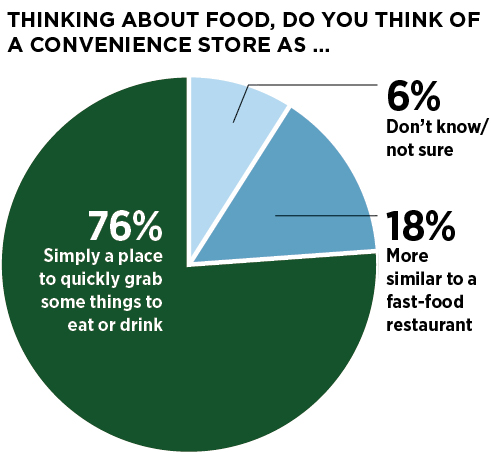
Worse, by a 3:1 margin, consumers define c-stores as a last resort for food as opposed to a destination. Also concerning is that only one in 11 frequent convenience store customers, defined as those who visit a c-store at least three times per week, say that they consider c-stores a destination for food (9%), the same percentage as the general population.
Opportunities Abound
Although the lingering negative perceptions around convenience store food are concerning, they also point to opportunities. In the survey, consumers also told NACS what they like—and what they want—from c-stores.
First, consumers like the broader selections at convenience stores that allow them to create their own self-defined combo meal, as opposed to the more limited options at QSRs. Three out of four consumers (75%) say that when buying a meal at a convenience store or QSR, it is at least “somewhat important” that they can select any snack or drink to go with their meal as opposed to only having combo meal choices, and 36% say it’s “very important.”
This preference gives c-stores a competitive advantage over QSRs. Retailers who can highlight “build-your-own” meals—mixing hot food with packaged snacks and drinks—can emphasize both convenience and customization without significantly adding operational complexity.
Second, c-stores have the advantage of speed of service. Consumers are nearly twice as likely to seek out premade food that is ready to grab and go than made-to-order food (35% versus 20%)—that presents a huge opportunity for attractively packaged and displayed commissary items. Those ages 50 to 64 are the most likely to opt for premade items (42%).
By offering both commissary and made-to-order food—and promoting it—retailers can offer consumers the flexibility they’re looking for. C-stores can win the competition with QSRs by focusing on the options that they provide: fresh, ready-to-eat items for customers in a rush and made-to-order options for those willing to spend a few extra minutes.
Third, a focus on fresh and healthy foods is a continuing trend that ties into commissary offers. Nearly one in three consumers (31%) who shop at c-stores say that they are likely to select fresh items like a fruit cup, salad or parfait—that percentage increases for customers aged 18 to 34 (39%) and frequent c-store customers (40%). In addition to fresh items, nearly one in four customers say that they are likely to purchase health bars (23%).
Still, it comes down to choice and addressing a specific occasion. While some consumers say their preference is to buy something healthier at a c-store, 64% say their preference is to get something indulgent.
Keeping It Clean
Cleanliness is essential to growing foodservice sales. Most QSR customers don’t see kitchen operations or general cleanliness because the majority of orders come through the drive-thru. Because customers don’t have a lot of recent experience inside the store, their perceptions of cleanliness in QSRs is set in place.
C-store customers, on the other hand, can see the operations in the kitchen, seating area or the general floor space. Bathroom cleanliness remains essential, given that 31% say they used the restroom last time they went inside the store after purchasing fuel.
Trust in food quality hinges less on what’s on the menu and more on what customers see throughout the store. Cleanliness was cited by more than three in four consumers (77%), and an even higher percentage of women (80%). For retailers, this means that food credibility starts on the sales floor. Clean equipment, organized displays, minimal clutter and visible freshness can build confidence in c-store foodservice.
Consumers Expect Freshness and Taste
Consumers say they make their food-purchasing decisions at c-stores based on their ability to customize, availability of grab-and-go choices, access to healthy options and cleanliness of operations. But to keep them coming back, it comes down to two factors: Is it fresh and does it taste good?
Freshness and taste led, but economic considerations, including price, value and portion size are also top of mind for consumers. Speed of service, a core c-store attribute, was in the bottom half of considerations for c-store food.
There also are some interesting preferences based on subgroups. Frequent customers are more likely to say portion size (55%), new or unique items (35%) and the ability to customize (44%) are “very important,”—all considerably higher than the public at large.
Meanwhile, younger customers prize healthy options: 44% of respondents ages 18 to 34 say healthy options are “very important.”
Foodservice continues to be an important part of the industry’s future. By listening to what customers say they want and fulfilling their expectations, there’s no reason to think that the next 20 years won’t see growth as strong as the past 20 years.
.jpg?language=en-US)