This article is brought to you by Structural Concepts.
For another consecutive year, foodservice led convenience inside sales in 2025. Foodservice accounted for 28.5% of the total sales mix—up from 11.9% in 2005—and 38.9% of in-store gross profit dollars. Across the industry, a pattern continues to become clear: Foodservice is a growth and profit opportunity for operators.
“C-stores are in a perfect spot right now to capture market share of foodservice customers,” said Danielle McMiller, vice president of marketing at Structural Concepts, a manufacturer of temperature-controlled display cases. “They are positioned to meet the new better-for-you health trends and changes in consumer eating habits due to GLP-1s, and are keeping their stronghold on packaged beverages.”
Merchandising food items and products effectively can drive sales and increase basket sizes. “Merchandising strategy is what allows consumers to really engage and interact with your offerings, and operators can optimize sales versus limiting themselves to what types of products they can put in a cooler—which can create cross-selling opportunities,” said Patrick Rooney, director of marketing at Structural Concepts.
“With the right food products, the right merchandising elements and the right equipment to present it all, it’s the perfect combination that’s really going to allow c-stores to shine,” McMiller added.
Breaking Down Barriers
According to a study conducted by Structural Concepts and data consulting company Kantar, customers are 50% more likely to buy items from an open cooler versus a closed-door cooler. They can find the products that they’re looking for more easily—the study found that customers spend 10% less time (or around 15 seconds) in front of the open cooler versus a cooler with a door, even when the items in each are the same. Participants in the study also spent $1.23 more (11%) when shopping from an open cooler.
In an aisle with both cooler options, 63% of participants gravitated to the open cooler first. “It makes a difference that there are no barriers between the consumer and the products,” said McMiller. As a reason for choosing it first over a doored cooler, participants said the open cooler was easy to shop and provided easy access to products. Without doors as a barrier, customers were more impulsive, selected items faster and put more items in their basket.
“In c-stores, we are seeing a lot more open coolers or smaller displays in the center store, closer to checkout or on end caps to get that impulsive buy from the consumer,” said McMiller. “People shop with their eyes and they want accessibility, so when something is in front of them and creates a barrier, it can stop them from buying more.”
Open coolers, islands and gondolas also lend themselves better to cross merchandising, allowing retailers to showcase products together and allowing consumers to build meals in their minds.
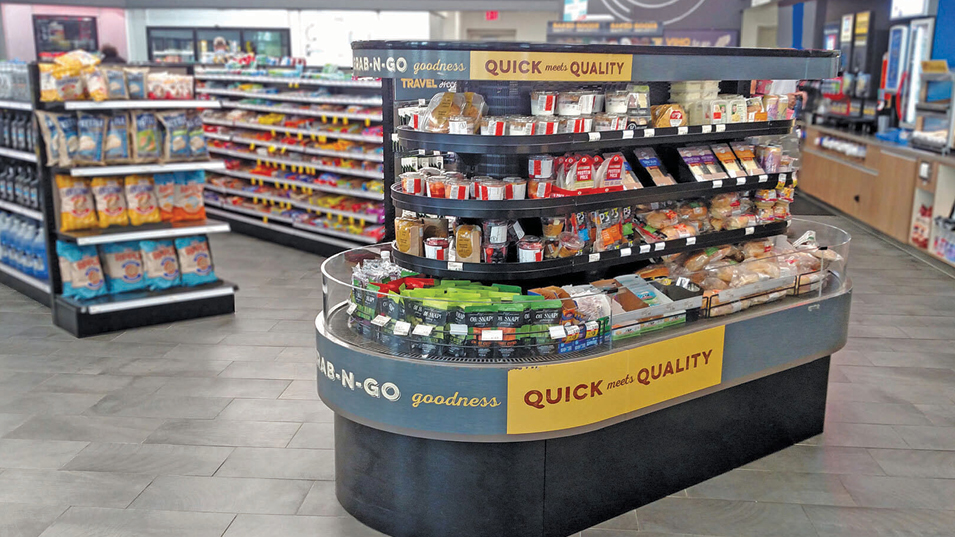
“With a cooler door, you’re only looking at it straight on and typically it has the same product row after row,” said Rooney. “Ours are designed to showcase the whole suite of fresh food options—salads, sandwiches, prepared meals—and beverages together, creating an enticing sightline and as well as that impulse opportunity for the customer that maybe only came in for one specific thing, but is now adding to their basket.”
End caps and undercounter units can also help merchandise every square foot of space in c-stores’ small footprint and optimize the inventory, said Rooney. Placing salty snacks next to island coolers, for example, can encourage the customer to build their basket.
Dual hot and cold merchandisers can also save space in a small footprint and allow retailers to present more food options to customers.
Less Labor, More Autonomy
No retailer is immune to challenges around labor. Tight headcount and high turnover often mean that it’s critical for store teams to prioritize efficiency.
“There’s no magic button,” said McMiller, but compared to doored coolers, open coolers can be easier for employees to stock with easy access from the front and/or rear doors.
“Not having doors makes loading, merchandising or refilling coolers easier and faster,” Rooney said. “It gives operators more flexibility and opportunity. As promotions or dayparts change, you’re able to rotate stock quicker.”
The company’s Q Series merchandiser was developed specifically for convenience settings. “The intent was to be low profile with a rear ledge that was accessible so that you could see into the kitchen and the prep area, and still be interactive with the customer and be able to load from the back of the display,” said McMiller.
McMiller said one piece of equipment that has been increasing store labor efficiency is autonomous merchandisers. “We’re on the verge of those autonomous merchandisers being a game changer for a lot of operators.”
Autonomous merchandisers can provide access to fresh food for consumers during off-peak or store closure hours. The company said it has particularly seen adoption in California markets with heavy EV-charging usage. These merchandisers “give the customer the ability to grab what they want, pay right there and leave,” said McMiller. “It takes the labor away from having to work the register and other areas, so you gain that labor back to then deploy to other areas of the store.”
Many consumers also prefer contact-less shopping. According to data from the company, automated stores had an 11% sales lift compared to stores with little to no automation, as well as an 11% increase in trip frequency.
“The difference between autonomous merchandisers and vending is that autonomous merchandisers are not a single transaction for a single product—once a consumer swipes their card, they can open the door and get as much product as they need. There is a higher ticket price and a much higher quality of food available,” said McMiller.
She noted that 74% of small and mid-sized businesses in a study said they expect their customers to continue to prefer contactless payment as much as or more than they do currently.
“Some people just want to be in and out of the store quickly, especially in convenience. Perhaps they don’t want to wait in a line. That’s where I think these autonomous merchandisers have a big role,” said Rooney.
Proactive Monitoring
Equipment downtime can be detrimental to profits—and reputation. An out-of-commission cooler can result in lost foodservice sales and diminished customer experience.
Structural Concepts new FreshWatch remote monitoring program, launching this summer, monitors more than 10 data points to help operators pinpoint where an error might occur ahead of one actually happening, reducing downtime of equipment and maintenance.
“There’s a proactive element of this data being available and being able to understand when something isn’t going the way it should ahead of the unit breaking down,” said McMiller.
Technology like FreshWatch can also help reduce labor. “Retailers want equipment to be functional—to do its job in a way that they don’t have to worry about it. One of the biggest challenges they have is that they don’t have the labor on site to keep a close eye on equipment, and don’t know something is wrong until it’s too late,” said McMiller. “From our perspective, it’s about peace of mind—for the operator, their store teams and the customer.”