It sounds like a blip in retrospect: U.S. driving, in terms of miles driven, fell about 15% in the pandemic lockdown year, then rebounded to record levels by 2023, when Americans drove roughly 3.26 trillion miles, according to federal highway data.
Commute times have nearly snapped back, too, with the U.S. Census Bureau putting the average one-way trip at 27.2 minutes in 2024, just about where it was before Covid reshuffled the workweek.
But for some convenience store retailers, especially those built around downtown office workers, the numbers tell only half the story. The commute is back. The commuter is different.
That distinction matters at c-stores, an industry that has long made a business of routine. Coffee before the train. Bottled water after the gym. A banana, phone charger, protein bar or pack of gum grabbed between the parking garage and the office elevator. The transaction may be small, but it is powered by repetition. Break the routine, even by two days a week, and the model changes.
Waiting to Recover
Ray Huff has lived that change from the inside. The president of HJB Convenience Corp., which operates Russell’s convenience stores in office towers and urban locations, has been through sudden traffic shocks before.
After the 1995 bombing of the Alfred P. Murrah Federal Building in Oklahoma City and again after the September 11 attacks in New York, office workers stayed away from high-rise buildings. Sales fell sharply and quickly. Yet the pattern, as Huff remembers it, was familiar: fear, absence, gradual return.
“At the time, we might have had 42 stores, and we might have seen a sales drop overnight of 30%,” Huff said of the Oklahoma City period. “But within three months, four months, we’d begin to see it creep back up.”
“This is the first one we haven’t recovered from,” Huff said of the pandemic’s effect on his downtown stores.
The difference is technology. After earlier disruptions, the office remained the place where work had to happen. After Covid, Zoom, Teams and other tools made work portable enough that many employers stopped measuring attendance in five-day increments. “I really expected to recover from the Covid incident also, but I think what happened is technology stepped up to fill the need to keep the businesses going,” Huff said.
Huff sees it in the sales curve. At one Los Angeles location, business has recovered to about 90% of its pre-pandemic level, with Tuesday, Wednesday and Thursday sometimes exceeding old sales patterns. Monday and Friday, however, remain weak. Another Los Angeles store is stuck at roughly 40% of pre-Covid sales. In Denver, where HJB once had 14 stores, the company now has three operating and two mothballed; the others have been released.
“If people are there, we will be successful,” Huff said. For Huff, downtown retail has become more site-specific, landlord-specific and day-of-week specific than it was before 2020.
Out of the Office
National data supports the split picture. The Federal Highway Administration’s long-running Traffic Volume Trends reports show that U.S. vehicle miles traveled have recovered to record levels, yet telework and working from home remains far above pre-pandemic norms.
The U.S. Bureau of Labor Statistics reported that 35.1 million people teleworked or worked at home in August 2026, representing 21.6% of people at work, down from 22.1% a year earlier. The Census Bureau’s commuting data show travel times nearly back to normal, but that average can hide a changed rhythm: fewer daily office trips from some workers, longer trips from others who moved farther out, and more discretionary errands during the middle of the day.
“It’s next to crazy the amount of traffic that’s moving [in and around Denver],” Huff said. “They’re just not coming downtown.”
That new rhythm is most visible in metropolitan areas. In northeastern Illinois, a Chicago Metropolitan Agency for Planning survey found that the share of residents telecommuting at least once a week rose from 14% in 2019 to 46% in 2024-25. The same report found midday travel rising meaningfully, with trips between the traditional morning and evening peaks reaching about two-thirds of rush hour levels, compared with less than half before the pandemic.
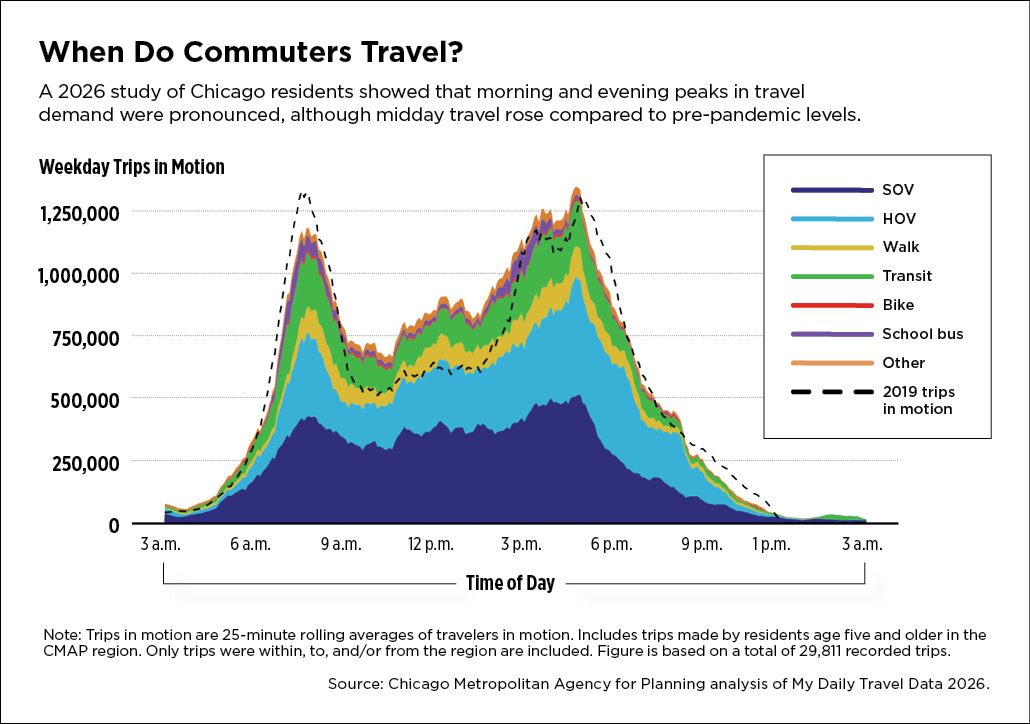
For roadside convenience stores, that can be good news. If hybrid workers are driving to school pickup, medical appointments, fitness classes, lunch meetups or midafternoon errands, stores located along suburban corridors may see new dayparts emerge. The morning coffee rush may be less dominant, while late morning and midafternoon trips become more valuable. Operators can adjust labor, foodservice production and promotions around a wider traffic window.
Unsettled Cities
The challenge is sharper for stores that were designed as office amenities. Huff’s model depends on dense, predictable populations inside large buildings. Over decades, he learned to translate square footage into sales. “If you tell us there’s 5,000 people in the building, we can calculate sales within 5% or 10%,” Huff said. “But when we’re off 40%, 50%, then something’s wrong.”
A 1-million square-foot, tower implied several thousand workers. If those workers were in the building five days a week, a small-format store with coffee, snacks, beverages and essentials could become part of the building’s value proposition.
In the old math, the store was not merely a tenant. It was an amenity. Huff said landlords understood that a Russell’s downstairs could help them command higher office rents because tenants wanted services in the building. “What they did is they said if they had a Russell’s downstairs, it added a dollar per foot to the rent that they could charge,” Huff said. “So, a million-square-foot building, they could charge an extra million. We would be an amenity.” That logic still applies, but only if there are enough people upstairs to use the service.
“If people are there, we will be successful,” Huff said.
That caveat now drives lease negotiations. A store serving a three-day office week cannot pay rent as if it serves a five-day week. Huff said he has adjusted lease terms to reflect the lower traffic base, and some landlords have done the same. “I’ll modify my lease terms to reflect that, so a 40% drop in rent,” Huff said. “The landlords are like, OK, we know— just be open.” Smart landlords, he said, realized during Covid that keeping the operator in place mattered more than enforcing pre-pandemic economics that no longer matched the foot traffic.
Others took longer to understand the shift. Huff describes some locations as being in mothballs: signs down, shelves cleared, product removed, point-of-sale equipment shut down.
“We put paper on the windows so you couldn’t see in them,” he said. “We took out all of our products, but we could reopen them in a week. We just need to restock them, put the point of sales back in, put the signs back up.” The stores could reopen quickly if the building population returns, but keeping them idle still carries costs. Utilities, maintenance and opportunity costs accumulate while downtown waits for a renaissance.
What Comes Next?
Denver may be one of the clearest laboratories for that next version. Huff gives the city credit for trying. The 16th Street Mall has been rebuilt at great expense, with a cleaner, more open design intended to bring people back to the corridor. Denver has also supported downtown business incentives and office-to-residential conversions as part of a broader effort to address vacancy and rebuild street life.
“The city is being very proactive because they realize it hasn’t gotten better,” Huff said. “They are trying to do the conversion from an office to residential, but it will take three to four to five years.” Those steps are important, but they are not quick fixes for retailers whose sales depend on daily office density.
Office conversions, in particular, point to the long-term answer and the short-term pain. Turning a large office tower into apartments can eventually give downtown retailers residents instead of commuters, evening demand instead of lunch-only demand, and seven-day traffic instead of a Tuesday-through-Thursday spike. But the construction and financing timelines are long. Office buildings were not built like apartment buildings. Plumbing, electrical systems, floor plates and life-safety requirements can make conversion expensive and slow.
For convenience retailers, the strategy is becoming more granular. Stores near highways and suburban arterials may lean into flexible-day traffic: foodservice that works beyond breakfast, promotions tied to errands rather than commuting, and labor schedules that recognize a flatter rush hour. Urban office stores may need stronger landlord partnerships, lower fixed costs, more delivery to upper-floor tenants and merchandise mixes that serve hybrid workers when they are in the building.
The old commuter was predictable. The new commuter is conditional. She may come in Tuesday through Thursday, drive instead of ride transit, arrive later, leave earlier and run errands at lunch. He may live farther from the office but tolerate the trip because it happens only a few days a week. Both still need coffee, snacks, beverages and convenience. They just no longer need them in the same place at the same time every weekday.
That is the post pandemic commuting story for convenience retail. The country is moving again, but movement has become less centralized. The roads may look crowded. Downtown may feel lively at night. Office workers may be back three days a week. Yet for retailers built on the certainty of five-day foot traffic, the recovery remains uneven.
Huff is not counting downtown out. He has seen business districts empty before and recover. But this recovery depends less on a return to 2019 than on a new alignment among workers, employers, landlords, cities and retailers. If people come back, the stores can work. If they come back only part-time, the economics have to come back part-time, too.