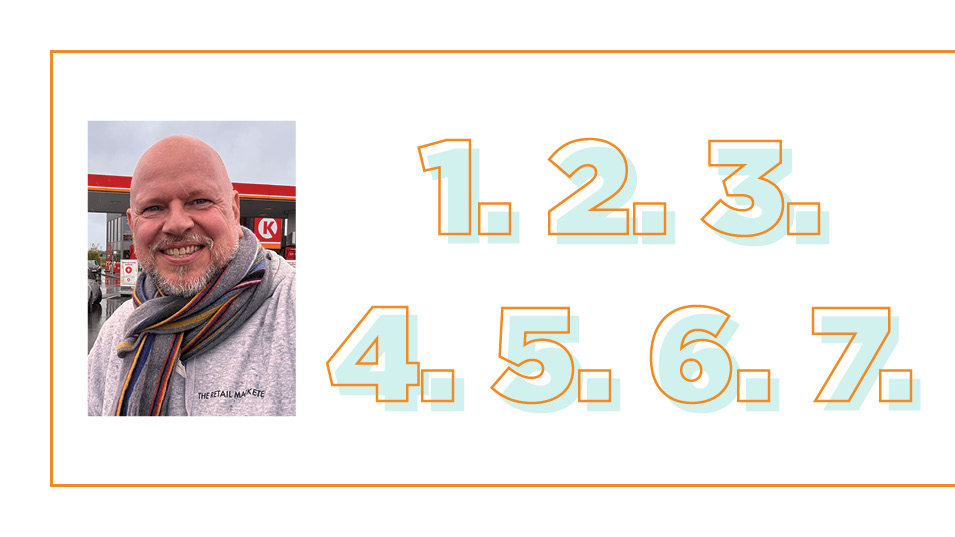
Most of my working life is spent inside other people’s stores. Around 1,000 a year, across more than 20 countries on three continents—forecourts in Scandinavia, city-center concepts in Poland, travel centers in Texas, kiosks in Switzerland, motorway sites in Germany, where I started on the fuel side and never quite left.
The question I get asked never varies: Which country has the best convenience stores?
I’ve become convinced it's the wrong question. The best store anywhere is only the best answer to one customer, in one place, at one moment. The store doesn’t travel. The thinking behind it does.
So instead of another trend list, seven signals—things I keep noticing that don’t yet feel settled enough to call trends. A trend implies certainty; a signal is something emerging, for thoughtful operators to interpret themselves. Underneath all seven sits one conviction: The coming decade won’t be won by the companies with the biggest stores, the newest technology or even the best coffee. It will be won by those who understand why the customer left home in the first place.
1. Convenience No Longer Competes With Convenience
Twenty-five years ago, running non-fuel retail for a major oil company, our competitive set fit onto a single slide: the network across the street, and the one after that. We watched their pump prices, their car wash promotions, their sandwich deal.
That world has gone.
The same customer now chooses between our store, the drive-thru, the bakery chain, the supermarket’s grab-and-go wall, the delivery app, the office kitchen and the rather good coffee machine on their own countertop since the pandemic. Increasingly the choice is between our store and not stopping at all—the trip consolidated, ordered ahead or simply skipped.
The operators who impress me most have stopped asking who their competitor is. They ask something harder: Which mission are we trying to win?
The morning fuel-and-caffeine run. The 8 a.m. reward. The lunch that has to happen in 11 minutes. The evening rescue mission, when dinner isn’t happening at home. Each carries a different competitive set, a different price tolerance, a different definition of speed.
Organize around missions rather than competitors and everything downstream shifts: what you carry, where you place it, what your menu board leads with. Category management asks what sells. Mission management asks what job the customer hired you to do. The second question is the uncomfortable one, because sometimes the honest answer is that nobody is hiring you at all.
2. Foodservice Stopped Being a Category and Became the Operating System
Across Europe I now meet companies putting more capital into kitchens than into forecourts. Not foodservice bolted onto a store, but foodservice as the organizing logic of the business: the site laid out around production flow, staffing planned around dayparts, fuel reduced to one traffic driver among several.
Valora—the European arm of Mexico's Femsa—is the clearest proof point I know. Its first Avec store with an integrated The Kitchen concept opened in May 2024 in Zurich, serving to-go dishes prepared fresh in an open kitchen Monday to Saturday. On Sundays the store runs entirely without staff: entry, shopping and payment handled through the Avec app. One site contains the whole shift: The kitchen sets the footprint, the labor model flexes with the daypart curve and when the kitchen goes dark the store switches into an autonomous format instead of closing. The Zurich flagship made Valora the first retailer from the German-speaking region to win NACS European Convenience Retailer of the Year. The structural signal is louder still: Valora has merged its convenience retail and foodservice B2C divisions outright. Kitchen and shop are no longer two businesses sharing a roof.
I call this Foodvenience, deliberately, because “foodservice” no longer describes what is happening. Foodservice is a category you add. Foodvenience is a business model you become: the point at which a company stops selling fuel with food attached and starts selling food with fuel attached, where hunger rather than the fuel gauge decides whether a customer turns in.
The logic is simple. Fuel brings people to the site. Food brings them back. Good food creates frequency, frequency creates habit, habit creates loyalty—and loyalty is what the capital markets are actually paying for. Watch how investors have valued convenience assets recently: premiums flow to businesses that own occasions, not volume. Occasions recur whatever is in the tank. Volume does not.
Europe offers a fascinating laboratory because the differences are so pronounced. In the Nordic markets, roadside retail is estimated to capture 15 to 20% of the total out-of-home foodservice market. In Germany, its share remains closer to just 1 to 2%. The markets are only a short flight apart, and consumers have the same fundamental need for convenient, high-quality food on the move.
The difference is not appetite—it is ambition and operational conviction. It comes down to kitchen capacity, staffing models, throughput, consistency and, ultimately, whether foodservice is treated as a strategic growth engine with real authority behind it—or merely as an add-on to the fuel business. Nobody drifts into Foodvenience. It gets chosen, usually by one person willing to defend a capital request the fuel P&L cannot justify.
For U.S. operators, many well ahead of Europe here, the signal isn’t “do foodservice.” It is that the food business eventually stops being a department inside a fuel company and becomes the company—something most organizations work out years after their customers have.
3. The Winners Don’t Sell Products—They Sell Something Worth Being Seen With
One of my favorite examples comes from outside our industry. Walk past an Oakberry açaí counter in a European city center and watch what people do with the cup. Nobody pays a premium because frozen fruit is expensive. They pay because the product looks like the person they want to be that day: modern, healthy, colorful, Instagramable.
Younger customers buy identity before ingredients. That isn’t vanity, it’s efficiency. With near-infinite options, the quickest way to choose is whatever fits your self-image.
The implication runs well beyond social media. The presentation layer of your offer isn’t decoration—it is part of the product. The cup. The wrap. The lighting over the bakery case. Whether the fresh food looks made or looks stored.
I visit far too many stores where the food is genuinely good and the presentation quietly says otherwise. Customers rarely remember ingredients. They remember how the transaction made them feel about themselves.
4. The Scoreboard Is Shifting From Traffic Acquisition to Time Monetization
For decades our industry measured itself in counts: cars, transactions, gallons, footfall. Those metrics assume time on site is a constant.
That assumption is breaking. Electric charging is the obvious accelerant—20 minutes is an eternity in a business engineered around 90 seconds—but not the only one. Parcel pickup, order-ahead, seating, coworking corners and good restrooms all extend the visit.
The useful question is no longer how many customers came, but what happened while they stayed. If a customer is with you for 20 minutes, what have you given them to do, buy or enjoy in minutes 3-18?
The operators getting this right are designing dwell rather than tolerating it. They aren’t processing transactions any more. They are hosting.
5. AI Won’t Replace Retailers—It Will Replace Average Retailers
Wherever I travel, AI dominates the conversation. Far less often does it dominate the P&L.
The gap is consistent. The companies generating real advantage aren't the ones with the best AI narrative for investors. They are the ones quietly using it to strip friction out of unglamorous processes. Demand forecasting that cuts morning stockouts and evening waste. Labor scheduling matched to real dayparts instead of historical habit. Price optimization at site level rather than network level. Fresh food ordering a store manager trusts enough to stop overriding.
None of that makes a keynote. All of it makes money.
There is a second-order effect. These tools compress the distance between a well-run site and a brilliantly run one, because they encode good judgement and distribute it. What they cannot do is rescue a weak concept or a team that doesn’t care. AI raises the floor of execution and, in doing so, raises the price of being average.
The technology is not the strategy. Execution has always been the strategy. AI simply makes execution measurable—and therefore harder to fake.
6. Global Scale Is Learning to Sound Local—and Local Is Learning to Run Like Scale
The observation from Europe that has surprised me most in two years: Several of the strongest-performing concepts are becoming less standardized, not more.
Regional bakery partners instead of one central supplier. Local craft beverages beside the global brands. Menus that vary because regions genuinely eat differently. Store graphics referencing the neighborhood rather than the network.
Meanwhile the independent operators I work with in Germany are professionalizing fast: proper data, category discipline, buying groups, shared technology, employer branding unthinkable a decade ago.
Two curves are converging. Global players are buying local emotional relevance. Local players are buying global operational excellence. Whoever completes that arc first wins the next decade.
The practical question for large networks is which decisions genuinely need to be central. Safety, systems, buying leverage, brand promise—yes. What goes into the bakery case in a town of 12,000 people—much less obviously. Standardization solved a control problem in an era of poor information. We no longer have poor information.
7. The Most Under-Traded Asset in Our Industry Is Female Leadership
I’ve kept the most commercially interesting signal until last, because it is most often filed under the wrong heading.
Everywhere I go I meet outstanding women running stores, regions, operations and marketing. The talent is already inside our companies. Then I look at the boardrooms and the CEO shortlists, and the pipeline narrows to a thread.
The numbers make the mechanism visible. Russell Reynolds Associates' 2024 analysis of the S&P 100 found women holding 9% of CEO roles. More revealing is what sits directly beneath: 8% of COO roles, 20% of CFO roles and 24% of P&L leadership positions—precisely the seats chief executives are chosen from. Meanwhile women held 72% of CHRO roles, a job almost nobody is promoted from into the top one.
That is not a supply problem but a routing problem. Capable women are steered into functions that support the P&L rather than own it, then judged unready for a job they were never routed toward.
Why does this belong in a commercial article rather than a diversity one? Because the performance data has stopped being ambiguous. McKinsey's study of more than 1,200 companies found firms in the top quartile for board-level gender diversity 27% more likely to outperform their peers financially than those in the bottom quartile; those in the bottom quartile for both gender and ethnic diversity were on average 66% less likely to outperform, a penalty that has widened with each edition. This is correlation, not automatic causation.
Now apply that to our industry. Half our customers are women. Our fastest-growing categories are food, health and freshness. Our future depends on hospitality instincts rather than fuel logistics. A leadership team drawing from half the talent pool isn’t making a values choice. It is accepting a handicap in exactly the capabilities it needs most.
The fix is unglamorous and within our control. Put women into P&L roles early rather than late. Sponsor rather than mentor: Sponsorship costs the sponsor something, which is the point. Make succession lists visible. And run one audit this quarter: Count how many women in your company have ever carried a P&L. If the answer is uncomfortable, your pipeline problem isn't in recruitment.
An industry that serves everyone should, eventually, be led by everyone.
So, which country has the best stores?
I still get asked—and still think it’s the wrong question. The better one: Which retailers understand their customers better than everyone else?
Great convenience retail was never really about fuel, coffee or sandwiches. It has always been about making somebody’s day slightly easier than it would otherwise have been—true when I started, and true long after the fuel mix, the technology stack and store format have changed again.
The fastest-growing companies I visit, on every continent, have worked out the same thing. They no longer try to sell people products.
They are trying to become the most convenient part of someone’s day.