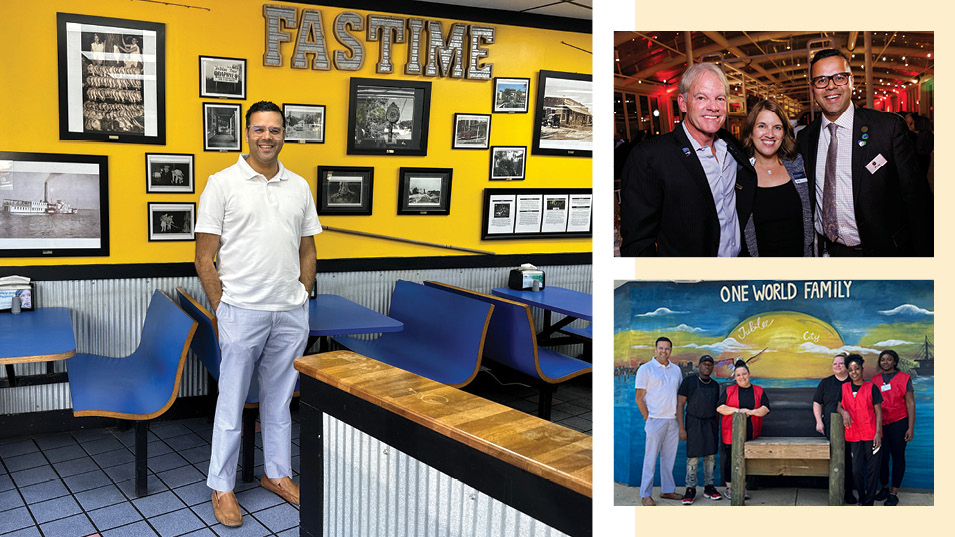
Fifteen years ago, Jigar “JP” Patel, who runs the three-store convenience chain Fastime, and three of his friends were “just a few guys sitting around the table” one night, talking about how hard it was to be an independent operator in the convenience industry. “It was hard to compete, given that the large chains and corporations had really figured out the science behind this business,” he said. “They had scale, so it was hard as an independent operator to provide the same level of service to our customers.”
The four retailers decided to pool their resources, combining their stores to form a buying group. “We wanted to create some sort of cost advantage to compete better in the industry,” Patel said.
That buying group became the Strategic Alliance of Affiliated Store Owners of America (SAASOA), a nonprofit organization created to give independent operators the buying power, knowledge and advocacy they needed to compete. The group started with about 25 stores and grew close to 60 by the end of the first year. It now has more than 7,200 members across more than 17 states.
“We were like, ok this is a lot of stores… so we needed to have a framework around it to work for the benefit of everybody,” Patel said. “That’s how SAASOA got started.”
That was almost 15 years ago. How has the organization evolved since its inception as a buying group?
The whole idea at first was to give vendors a dedicated order volume so that we could get better pricing. The main focus was creating a cost advantage. But we realized that a cost advantage alone was not going to raise the level of customer service, the standard of operations or the offerings in our members’ sites. You can have a good price on something, but if the customer experience is not on par, customers are not coming back.
So we decided to invest in education, and that is when the trade show came to be. The trade show has education sessions and keynote speakers in addition to the expo. Because most independent operators are family-run businesses, we also have some family-oriented events as well.
We’ve also leaned into the legislative side at both the state and federal levels. The more educated our members are, the more active and compliant they are.
If a retailer is a member of SAASOA, what does that look like?
There is the buying side, which is our base offering and gives retailers more buying power.
We’ve also invested a lot in technology. We created member and vendor platforms so that there is uniformity between the data that is being shared. It ensures people know exactly what they’re buying, at what price and what the sale price should be.
We are living in a technological age and our members need to be able to adopt new things that are coming to the market. They are going to get left behind if they don’t, so we equip them with tools that can make their businesses more efficient. For example, we have a planogram software that we built for them. They can plug their sets in and see exactly what they can do with the space in their cold vault, in their center store and their backbar, without having to do guesswork.
We also educate our members about how to get into foodservice if they’re not already doing it, how to get on scan data programs, or how to move up the tiers of their loyalty, among other things. We educate them on things that will move the needle.
If all convenience store operators, especially on the independent side, run their business well, the whole industry is going to benefit and customers will enjoy their experience more.
Independent operators are the largest segment of the industry. How are you empowering them to be better in their businesses, and what impact does that have on the industry as a whole?
Here’s the thing: the effort that goes into running a good convenience store and a great convenience store is almost the same. There is a very small difference. The challenge is keeping yourself updated on what is happening in the industry. What are the new trends? What are customers looking for? What are the new items? And as an independent operator, it’s hard because you wear multiple hats, and don’t always have the time or ability to step outside of your store and learn something new.
We always tell our members: Go to every trade show, meet new people, share best practices … and you will bring back new things into your store.
From attending events and taking international trips, I’ve seen firsthand that when all the stores are on the same level of excellence, everything is better for the customer. It is all of our jobs to pitch in to make this industry better. And we are just playing our part as much as we can.
Why is technology one of SAASOA’s top priorities right now?
With AI now in the mix, this is the right time to bring new tools and offerings to our members so that they can run their businesses more efficiently.
Independents wear multiple hats day to day, so we want these tools and technologies to give them time back so that they can invest in their education. The struggle for independent operators is that the majority of their time is dedicated within the four walls of their convenience store, and the time required for additional learning is very scarce. But events and gatherings are where most of their learning happens. It’s not just within the four walls of your convenience store. That’s where you go to prove all the ideas and concepts that you’ve learned elsewhere.
You recently partnered with the American Petroleum and Convenience Store Association (APCA). How are your two groups strengthening independents?
We are very excited about this partnership. It has been a long time coming. They have built an amazing presence at the state level in California, not only as an organization, but as a legislative team. All of their members have come together to fight any legislation that has been bad for the industry. That is something that we hope to learn from and incorporate in our own culture at SAASOA.
In turn, we bring our technological foundation to APCA and bring their members in California more buying power, more education and more offerings. We want to give them all the offerings that our SAASOA members in the Southeast and the Midwest benefit from.
As chair of the NACS political engagement committee, what are you focused on when it comes to industry legislation?
We are already strong at the state level, at the federal level, groups like SAASOA and APCA can make an impact by bringing all of our members into the mix to fight for bills like the Credit Card Competition Act (CCCA). Swipe fees are brutal. I can’t tell you how many times I’ve heard from a retailer that they pay more in swipe fees than they do for the rent or the mortgage on their businesses, which is crazy.
If CCCA were implemented, it would create one of the biggest cash flows for independents and be a big boon to this group, considering how much they currently pay on a monthly basis.
We have also been heavily involved in SNAP legislation and are currently working to bring more clarity to our retailers regarding illicit vapes, since there is not much coming from the FDA.
What’s next for SAASOA? What are you hoping to accomplish moving forward?
In the next two years, I would like to see at least 20,000 members on the SAASOA platform. I would like to see much stronger technological adaptation within our membership and see our members using AI tools to run their businesses more efficiently.
By doing so, they’ll have more time in their day, whether that’s to spend with their families or attend industry events. I would also like to see our members be more involved legislatively, both at the state and federal level. I want them at the tables where decisions are made.
You’re an independent operator yourself. How have these associations helped you in your own business?
When the SAASOA and APCA alliance became official, it made my store part of one of the biggest groups in the industry. With both groups combined, we’re at about 7,500 stores.
That would put us in the top five convenience store chains in the industry. So right there, vendors look at us differently. That is one of the biggest benefits that I have as an independent operator, that vendors don’t just see me as a one- or five-store operator, but see me as a member of this large group. That’s the whole point. This platform gives independent operators a voice, and that is very important for us.
What strengths have you gained personally from working closely with other small businesses?
When you’re doing things with the right intention, you learn a lot. When I first started this 15 years ago, I didn’t know much about the industry. But by attending events and meeting people one-on-one, I’ve learned so much about what problems people are facing and how they’re attacking them. I’ve learned that sometimes they’re not getting any help from their local, state or federal government.
My communication has gotten better. I’ve been able to understand what the industry pain points are and communicate those to groups I’m part of, like NACS. I have become a bridge to share what is happening on the ground level with those groups and bring light to finding solutions.
Independent operators don’t always have the time or the ability to go represent themselves, so I feel very privileged that I have the ability to do that on the industry’s behalf.
And I’ve grown a lot personally. I’ve learned to be more humble and more giving. Anybody who has even a little bit of desire to do something more for others should be part of this movement.
You can give back in a way that uplifts all the independent operators in the industry.
What are you most proud of in your career?
I have learned so much by being active in the industry and its organizations— NACS especially—and sitting at tables with the industry’s leaders, hearing how they think and approach problems. I’ve brought all of that back and become a better businessman because of that. It’s been a very fruitful journey, and I want to bring our members on that same journey.
I believe that independent operators are the backbone of this industry. My whole family was involved when we first started the business until we could scale into more stores, so we know firsthand that when they call it a mom-and-pop operation, it literally is.
One great thing we have always incorporated in our culture at SAASOA is that we don’t think that we need to bring down our competition to compete with them. That mindset is a loss for the whole industry. We have always viewed it as building ourselves up to be better competitors. We uplift our members so that they can be well equipped to fight for their own fair share in the competitive landscape. We are creating a win-win situation for our members, our vendors and our consumers.
This is the right time for the industry to come together and uplift the independent side of the business so that the entire industry benefits. I am very happy that SAASOA is on the forefront of that charge and that we are making such an impact on the independent side of the industry. We have amazing representation, and the future ahead is very positive for all of us.