Customers come to True North convenience stores across Ohio, Illinois, Wisconsin and Michigan for the experience, said fourth-generation owner Colleen Lyden.
“They come because they’re clean. They come because we have beautiful stores,” said Lyden, who works on special projects and whose family started the business in 1919. “They come to have that interaction.”
As True North’s 185 company-owned-and-operated stores grew more sophisticated and the business wanted to shorten the time customers spent in line, the retailer wanted a self-checkout solution that maintained that guest experience, explained Colleen Lyden and fellow family owner Bailey Lyden, who is vice president of retail.
Last year, True North started deploying a self-checkout solution, but the Lydens prefer the term “assisted checkout” for their setup that still allows staff to interact with and assist customers even as the device, made by Mashgin, identifies the goods customers put down on it to purchase.
“We have a lot of local stores with local people that come in every single day and they want that experience,” Colleen Lyden said. “They see the same person behind the counter. They become friends.”
Companies like Mashgin, Diebold Nixdorf, Toshiba, Deligo and many others are offering solutions for self-checkout. With advances in AI and AI vision, in particular, the options retailers have will only increase in number and complexity. Meanwhile, the human touch remains essential.
‘What Problems They’re Solving’
Suppliers need to communicate to convenience store operators the additional value their product creates, according to Frank Beard, principal at Konbini Strategy, a marketing and public relations firm.
“With any of this new technology, vendors have to be crystal clear about what problems they’re solving, because you don’t want to be a solution that’s in search of a problem,” Beard said.
One limit self-checkout technology must consider for convenience stores is dealing with age-restricted products like alcohol or those in the backbar, Beard said.
Beard thinks an ideal setup for convenience store self-checkout would be having two or three devices at the counter just off to the side of one or two cash registers that can still be staffed.
“That way, even if someone is using the self-checkout machine and they decide they want a pack of cigarettes, you have someone behind the counter who is able to quickly assist with that, get them what they need, check their ID and make sure that everything is staying compliant,” Beard said.
Mashgin’s Power Counter model can sit on the store’s checkout counter and doesn’t have a closed back separating it from cashiers or the store’s backbar.
The setup creates a bartender mode for “augmented” checkout, where staff can help customers with age-restricted items and other needs, said Jack Hogan, senior vice president of sales and partnerships at Mashgin.
“Most people are really excited to go visit their favorite bartender,” Hogan said. “By opening this up and making it so the cashier is not staring down at the counter, grabbing items, scanning items … it allows the cashier a much bigger chance to actually look at the customer to talk to them. They’re also able to flow and help multiple customers at once.”
Another newer feature Mashgin is deploying is an ability to automatically notify the customer about promotions, Hogan said.
“Because our system rings things up so quickly, it gives an opportunity to flash up, ‘Hey, you put two Red Bulls down. Are you aware that there’s a three for $5 Red Bull deal?’” Hogan said. “We’re trying to do it in a really tasteful way.”
Other technology can help with age restricted items.
TruAge® is the not-for-profit age verification solution from NACS and Conexxus—built so retailers protect their business without slowing it down. Customers scan a physical license or a digital ID at checkout with no new hardware required.
TruAge captures just four data points, seals them into a single encrypted token and returns an instant yes or no. Age and validity are verified and everything else is anonymized.
Employees never store, see or worry about a customer’s personal information, while retailers get a reporting trail as proof.
Reducing Shrink
A weak point of the traditional self-checkout experience is shrink, whether intentional or unintentional, and the awkward safeguards that are put in place to reduce shrink.
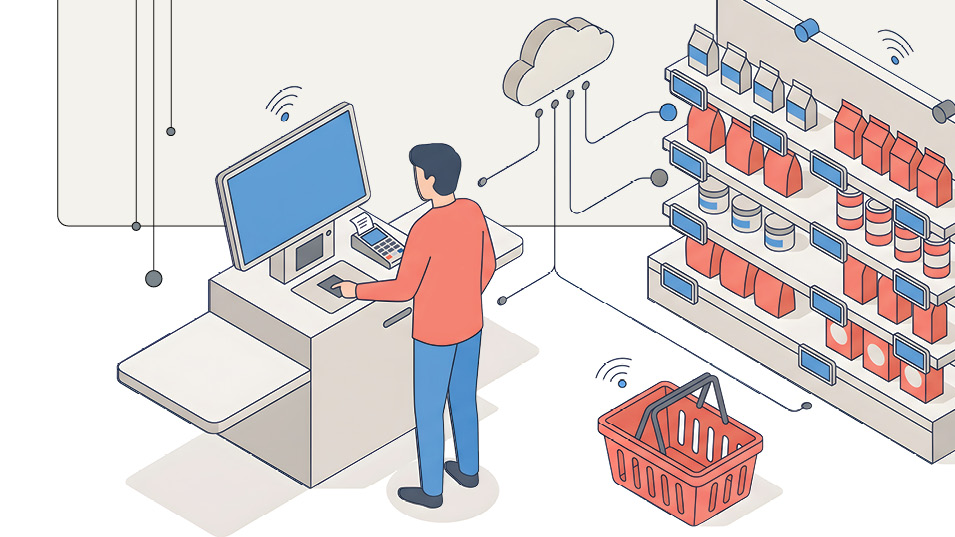
With Deligo’s solution, customers place their items down and the Deligo device instantly identifies the products through visual recognition. The Europe-based business is rolling out into convenience stores in the United States, according to Deligo CEO and co-founder Istvan Haidekker.
The company’s Deligo Air was designed for over-the-counter convenience store transactions, allowing staff to hand customers age-restricted items or freshly prepared food that the store operator doesn’t want to have out in a self-serve area, according to Haidekker.
“Our objective is to create a great experience, is to maintain that great experience more precisely, and bring speed and efficiency at the same time,” Haidekker said. “And do it in a way that doesn’t have a negative impact on the vibe, the experience, and ultimately the shrink.”
AI-powered computer vision at self-checkout has helped resolve missed scans and other issues related to shrink, according to Yeshai Bouskila, executive director of solutions and innovation at Toshiba Global Commerce Solutions.
Bouskila sees self-checkout trending towards vision-based machines like Toshiba’s MxP Vision Kiosk that identify all a customer’s purchases when they are put down.
“Think about just coming, placing three, four items on the platter. Vision identifies the items correctly,” he said. “You don’t have to rely on a customer to scan the right items or pick the right size for an item. … I think that this is where the industry will go to in the next couple of years as we see the adoption there.”
The vision-based machines use weight, shape and more for loss prevention and validation, he added.
Bouskila said this technology can also help in situations that aren’t theft but that could affect inventory, such as a customer scanning one bottle of soda four times when the customer is buying two sodas and two diet sodas that are all the same price.
Diebold Nixdorf’s Vynamic Smart Vision shrink reduction technology, meanwhile, can not only integrate with a self-checkout machine but also with other existing cameras in a store, said Diebold Nixdorf’s Harkawal Singh Malhotra, the director of fuel and convenience QSR channel operations for North America. For example, the system could flag a customer in a store aisle who put a bottle of wine in a backpack and then did not scan it at self-checkout.
“So if they do that, that tagged person would be followed with the software all the way to the checkout, whether they go to the cashier or self-checkout,” Singh Malhotra said. “Then if they don’t scan that item, they will be politely nudged.”
This year, Diebold Nixdorf has also rolled out Smart Vision systems for “unstructured” environments that can distinguish between shoppers in front of a self-checkout machine and assign them to the appropriate transaction, said senior manager of media relations Matthias Wowtscherk. The technology can also determine if items in a customer’s hands are products that need to be scanned or are items like a phone or wallet.
“Our objective is not to embarrass or make it difficult for either the retailer or the consumer, but to try to give them an opportunity to correct the behavior if it was done intentionally,” said Singh Malhotra. “So that they can complete the transaction, honestly, and not skip some items. So that is where we have built our platform, which integrates with different products.”
Diebold Nixdorf’s Vynamic Smart Vision can also identify items like fresh fruit and vegetables that don’t have a barcode. If a retailer sells two or three kinds of oranges, the self-checkout screen will prompt customers to select the kind of orange being purchased, according to Singh Malhotra.
“You don’t have to go and search that I’m buying bananas or I’m buying a watermelon or a papaya,” Singh Malhotra said.
Appriss Retail’s platform, meanwhile, analyzes data and identifies patterns that indicate fraud, human error or process gaps that contribute to shrink, said senior vice president of strategic alliances Pedro Ramos.
Transaction patterns that signal self-checkout shrink are consistent and detectable, showing up in ways like repeated scan-and-void activity on the same machine during the same shift or when high-value product categories show shrink clustered around specific windows of time or machines, Ramos said.
He added that AI identifies these signals faster and more accurately than humans going through raw transaction data.
“Over time, our conversations with convenience retailers have shifted to making the data tell retailers where to look,” Ramos said. “The biggest challenge for the convenience vertical is that many operators still treat self-checkout shrink as an unavoidable cost of doing business rather than a pattern that can be detected, investigated and addressed in the transaction data.”
Customized Checkout
Modern platforms allow retailers to tailor self-checkout hardware and software to the needs of each location, Bouskila said.
Toshiba calls its personalized self-checkout hardware option the MxP Modular eXpansion Platform.
“Redesigning a front end is a significant investment. Giving retailers the flexibility to adapt the hardware, software and customer journey without rebuilding the entire checkout area fundamentally changes how they can evolve their stores,” Bouskila said.
In one example, Bouskila pointed to the benefits of dual-lane kiosk solutions, which allow a lane to transition between assisted checkout and self-checkout as store demand changes.
“During slower periods, retailers often have checkout capacity that’s underutilized. A convertible lane lets the same associate switch between assisted checkout and self-checkout, improving utilization without adding more front-end equipment,” Bouskila said.
Toshiba analyzes factors such as cash versus card usage, basket size, age-restricted purchases, staffing patterns and customer traffic before recommending a checkout configuration, Bouskila said.
“Our goal is to work with the customer to understand what’s their budget, what’s their pain points, what are they trying to achieve,” Bouskila said.
‘More Sophisticated’ Stores
At True North, the retailer has added self-checkout to 17 stores, eight of which have the Mashgin Power Counter setup while the other nine have an older kiosk style.
At stores where self-checkout is deployed, the retailer averages about 37% of the transactions going through self-checkout, Colleen Lyden said.
Adding self-checkout isn’t about reducing labor, but reallocating labor, Bailey Lyden said.
“If your main motivation is reducing labor, you know, that’s a tough, tall task, especially with our stores getting bigger, more sophisticated, especially with foodservice,” Bailey Lyden said. “That’s just not the order of the day.”
The business is putting the technology into new locations as well as stores that undergo a raze and rebuild, said Colleen Lyden.
“We have some smaller footprint stores that probably will not be able to handle the Mashgin [checkouts],” said Colleen Lyden. “We have some stores demographically that we may not put them in.”
True North has given its self-checkout setup a nostalgic name after the first store the family opened in 1919: Fast Check.
“We wanted to brand that experience within the store as something outside of just Mashgin,” Bailey Lyden said. “It’s an old family brand that we had. It’s kind of cool to bring it back.”