If you’re reading this, you’re likely of an age where your default web browser is a search engine, like Google. Guess what—turns out that means you’re old now (even if you’re still objectively young). For rising generations, AI is now the default.
“My son is in middle school, and the homepage on his school laptop is Perplexity,” said Shyam Rao, founder and CEO of Tote, an AI-native POS platform. “Everyone is bought into AI—the shift has already happened.”
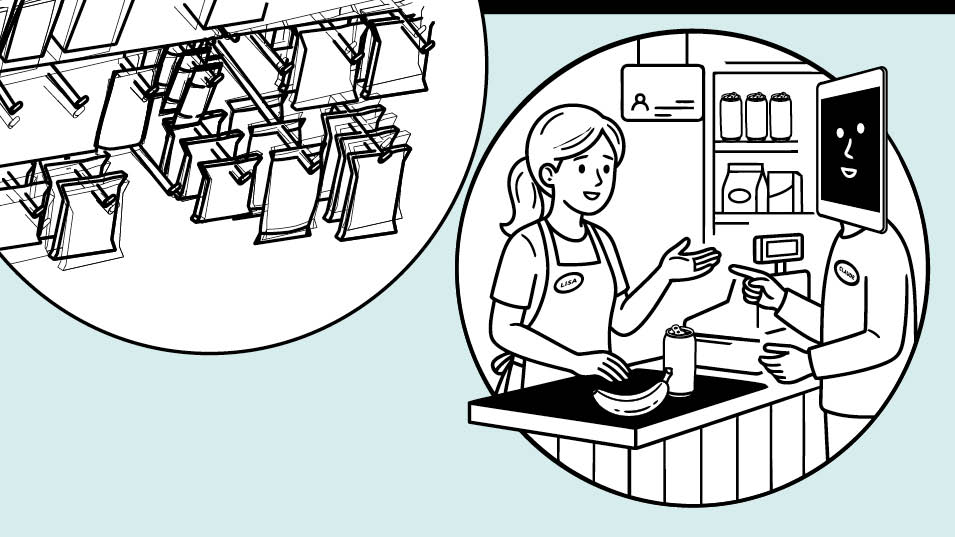
AI is also now becoming a tool for one of the most human-to-human roles—the convenience store frontline worker. With AI helpers for everything from inventory management and predictive maintenance alerts to standard operating procedures and on-demand training, frontline associates are leveraging AI to do their job better, and with less friction and more confidence. Frontline worker AI isn’t about replacing employees with AI functions—quite the opposite.
“We never let go of anybody because Claude is doing the job,” said Babir Sultan, president and CEO of Fav Trip, who operates five stores in the Kansas City, Missouri, area. He also founded Eagle Eye Live, an AI-based loss prevention startup for convenience stores. “It’s not about taking away jobs. There’s always something to do.”
The Associate Assistant
C-stores are notoriously complex environments. In one shift, a frontline worker may be running the register, stocking shelves, cleaning, cooking or preparing foodservice, fixing broken equipment or putting out any number of proverbial fires that could be catching in the store.
In some cases, they may be doing all that … while the only employee in the store.
Practical AI applications can look like streamlining onerous workflows, managing time-consuming manual processes and offering on-demand help for employees on the job.
“I always ask my team, ‘What is a tedious process that you don’t enjoy?’” said Sultan. “How do we offload that and make their life easier?”
In one example, he has essentially hired a “four-minute category manager.”
In his Claude account, he developed an agent that helps find new, popular and trending items to stock in the store. Fav Trip’s category manager asks it each day what the five top items are that the retailer should look at. Previously, that function would mean at least four to six hours per week combing the internet, looking at social media and sifting through Google Trends to find high-demand products. “We can now do it in four minutes. It told me to stock items I didn’t carry even a month ago that are now our top sellers. It gives me information like who the distributor is, what the margin would be, etc.”
Additionally, Sultan said he is in the process of testing new AI vision tools that could identify operational opportunities in real time, including alerts when staffing appears insufficient, when there are out-of-stock products on shelves or if there are busy areas of the store that require additional support or employees. “It might be able to tell me, ‘Hey, you’re very busy at this location, but there are only two people working,” Sultan said.
The On-Demand Trainer
AI is helping employees who may be new, still need additional training or haven’t yet internalized the vast amount of systems and processes they need to learn on the job. AI can answer on-the-spot questions if a manager isn’t available or if a frontline worker needs an answer quickly and doesn’t know where to find it. Turnover remains high across retail, and new employees often need to learn dozens of systems, procedures and policies in a short period of time.
“Imagine if you can ask an agent, ‘How do I clean the coffee machine?’ and boom, it pops up the five steps to doing it without having to go look for a manual,” said Bill Miller, president of GK Software USA, a cloud-based retail technology provider. “There’s an endless number of use cases.”
Miller said he is seeing retailers explore AI agents that answer questions about everything from return policies and cleaning procedures to merchandising requirements and product information. Because the systems draw from current company documentation, employees receive updated guidance instead of relying on outdated manuals or word-of-mouth knowledge.
“If somebody wants to return a half-eaten chicken (yes, that is a real example that happened to me as a retailer), what is the process for that? What am I supposed to do? What do I need to ask? How do I do it on the system?” explained Orit Bar-Ad, chief innovation evangelist at GK.
When Tote was developing its AI-based point of sale and store software, the team went into a client’s store and observed frontline associates in action. “What we saw was that when an associate struggled with something, their first solution was to ask their fellow coworker. That coworker might have started a month ago. Neither person had any idea.”
Next the employee found a manager, who directed them to a binder under the counter. The employee then flipped through stacks of pages trying to locate instructions.
“We were like … this is crazy,” Rao recalled.
Tote built an AI-powered assistant, its Genie AI feature, designed to serve as a concierge for frontline employees. Workers can ask operational questions through voice or text and receive guidance instantly in multiple languages or video formats. The AI can walk employees through lottery transactions, explain store procedures, answer foodservice questions or provide training support directly at the POS.
“The associates are expected to help a whole bunch of people, but who’s helping them? And that’s how we think about improving their experience,” Rao said.
He said an AI-based system that provides real time prompts, directions or answers significantly expedites employee onboarding and training. They’re essentially learning to use the system in real time.
AI can also be deployed to alert managers or store leads to training gaps and help them find fixes for workers. Employees often won’t tell managers when they’re struggling with something, said Kevin Farley, chief customer officer at InStore.ai. InStore.ai’s technology, which analyzes conversations at the counter and in the store and then uses AI voice analytics to surface operational improvement opportunities, can detect if employees say something on the job like “I’m having a hard time with this point-of-sale machine. I don’t know how to use it,” said Farley.
He said that if it’s a recurring thing employees are discussing, the operator can step in and provide additional training on that specific tool or process. It can even be directly connected to the retailer’s training system for improved tracking and management, he added.
The Career Coach
Sultan has also experimented with AI role-playing and coaching tools that simulate employee interactions with managers and provide feedback.
“We will have Claude or ChatGPT role-play with them, talk to them and break that barrier of hesitation and give them feedback,” he said. He might set the AI up to simulate a manager having a conversation with an employee who is upset because the store is understaffed, and will coach the manager on how to navigate that exchange. It’s a tool that empowers the manager to take action when the conversation occurs in real life, he said.
With InStore.ai’s conversation analysis capability, Farley said retailers could also use real customer interactions as training examples for employees.
“A manager could say, ‘Let’s listen to how this person interacted with the consumer.’ Maybe it was an angry customer and they diffused the situation. Maybe they did a great job of upselling the loyalty program,” he said.
Historically, those interactions disappeared and managers had little insight into what conversations were really occurring at the register. “But now there are these real-life training scenarios that you can share across your whole chain,” he said.
In addition to identifying top performers and using them as examples, Farley suggested focusing on developing employees in the “middle tier,” who have the most potential for growth, he explained. “Top performers will likely succeed regardless, while turnover naturally tends to occur among the bottom group. But those employees in the middle tier are looking for coaching, training, recognition for what they did well and feedback for what they could improve upon. If you can convert the middle tier into your more high-performing group, you will see your retention rate increase,” he said.
The Customer Service Rock Star
“Sometimes you encounter an employee where they’re just staring at the walls if they don’t know the answer to a question. With AI, they have a safe source to ask, and the customer gets an answer quickly,” Bar-Ad said.
AI can also help associates proactively identify and solve customer problems.
For example, a system may detect that a fuel pump is out of paper and alert employees before customers start complaining that they can’t get receipts. In one example from Farley, a retailer using InStore.ai discovered the culprit of its declining coffee sales at one location through conversation data.
“You might know what customers are buying, or not buying, but not why they make those decisions. What InStore. ai provides you is everything outside of the transaction log data,” said Farley.
Customers at the store were repeatedly telling cashiers that the coffee was cold. The cause was aging equipment that was no longer keeping the coffee hot, and once the issue was identified and the equipment was replaced, the sales recovered. “But that complaint may have not have made it to management quickly. An individual frontline worker may only have been told the coffee was cold once, and so made new coffee without knowing the equipment was broken. The same thing might happen to someone working the next shift and no one is communicating. But when analyzed all together, AI found a pattern.”
The insights can help retailers improve store offerings for customers while removing the burden from frontline employees to manually report every customer request, he said. “The goal is to provide Retail Frontline Intelligence and InStore.ai can connect meaningful dots. That simply was not possible before AI,” he added.
The Employee of the Month
AI is also creating new opportunities for employee engagement and retention.
Farley sees particular value in helping retailers better understand and support employees who might otherwise go unnoticed, maybe because managers didn’t witness outstanding behavior firsthand.
A highly engaged overnight employee, for example, may create excellent customer experiences despite working during periods when managers are rarely present. Traditional performance measures, like sales data, might miss that contribution entirely. “You’re not getting visibility into that, so how are you recognizing those employees?” he asked.
AI-driven analysis can identify those interactions and provide opportunities for recognition, he said.
The Change Management Cheerleader
Sultan acknowledged that workers were initially hesitant about using AI. But adoption improved when leaders explained why changes were being made and demonstrated how the technology could make jobs easier.
“We always tell them, if it makes your job more difficult, don’t do it,” he said. “If you can get your ‘why’ across, then that barrier to entry, that hesitation, breaks down very easily.”
At NRF 2026: Retail’s Big Show, earlier this year, Rachel Allen, senior director, talent acquisition at 7-Eleven, shared how the company implemented AI into its hiring and HR workflows, and underscored how critical employee buy-in is when deploying new tech systems.
“We’ll have a business strategy and then see where AI might be the problem solver. I think when you lead that way, you create a situation of building things with your employees versus it happening to them. A lot of the friction during implementations is because people feel out of control—like they’re not having a say in what’s happening to them,” she said.
She noted that from the get-go, it’s important to listen to frontline teams and be willing to adjust based on their feedback. This mindset helps “build champions” for change management.