This article is brought to you by GS1 US.
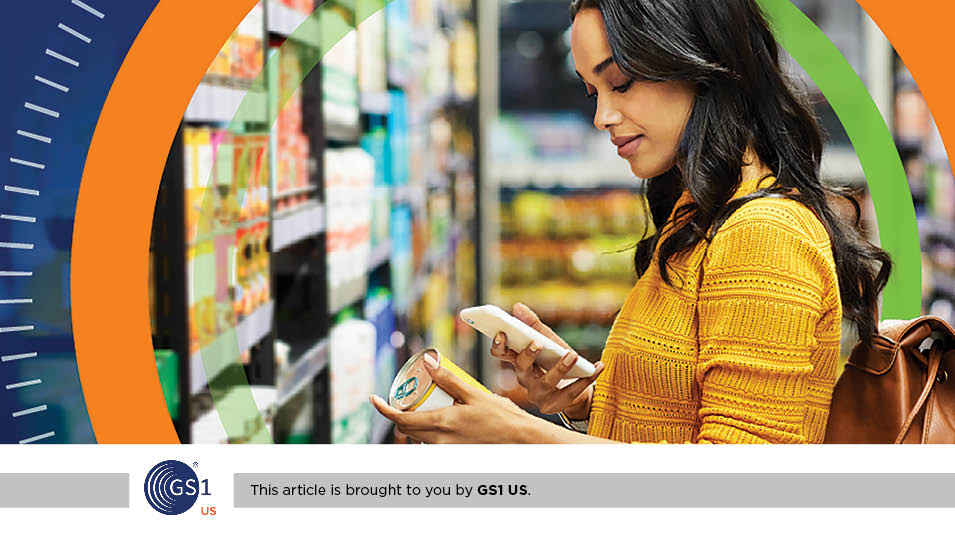
Retailers might not have thought about the barcodes on the milk, snacks or even fresh items that leave their stores in decades—if ever. But new barcode technology could help convenience retailers tackle some of their most pressing challenges, from managing perishables and responding to recalls to automating routine processes at checkout.
Barcodes have come a long way since 1974, when the first Universal Product Code (UPC) was scanned on a 10-pack of Wrigley’s chewing gum. Retailers are preparing for this technology to shift to 2D barcodes by the end of 2027, according to GS1 US, the not-for-profit administrator of UPC barcodes that is also leading the barcode transition.
Right now, the UPC barcodes on goods identify a product for checkout and that’s usually that. But 2D barcodes can contain and identify more information, such as expiration dates, lot codes and other data that can improve visibility and decision-making. Rather than just a series of black lines, 2D barcodes are grids made up of dark and light spaces. Most people will already be familiar with one variety: the QR code.
Retailers should be excited about the potential changes that 2D barcodes can empower, according to Lindsay Hillman, director of global standards at GS1 US.
With barcodes that can carry more data, a retailer could set up automatic markdowns based on expiration dates or direct a loyalty app to interact with a customer based on their purchase history.
“This is just the beginning for 2D barcodes,” said Hillman. “Point of sale is key for Sunrise 2027— that’s going to be the first driver, but there’s going to be so much future enablement out there.”
Automated Markdown Management
Hillman said that 2D barcodes can hold more information, such as expiration and production dates, batch/lots and serial numbers. The GS1 system of standards provides a common language for businesses to know what that information means.
“As adoption progresses, we’ll see brands begin to add additional data that’s relevant for their companies,” Hillman said.
One of the potential applications of that data in the 2D barcode is that retailers will have the ability to implement autonomous markdown pricing. For example, a convenience store could use data embedded in 2D barcodes to discount milk based on its sell-by date, Hillman said.
She added that combined with other in-store technology, the barcodes could lessen labor around price reductions. “They could do it on other markdown pricing models if they’ve got different types of electronics within their store space,” Hillman said. “They could trigger their system to mark down at point of sale based on the sell-by date carried within the 2D code. It really enables the opportunity to automate.”
She said the operator could decide to implement a markdown automatically, such as 20% off three days prior to a sell-by date and then 60% off one day before that date or enter the markdowns manually each time.
“The flexibility in how they would set up their system to automate these functions is really up to the retailer that’s making those choices, but the additional data carried in a 2D barcode enables all of that,” Hillman said.
Responding to Recalls
There are also safety applications for having batch/ lot data directly on a product through a 2D barcode. With that information directly connected to the product, scanning it could trigger a notification at checkout in the event of a recall.
“You’re able to stop that product from being sold in the event it wasn’t removed from the shelf fast enough,” Hillman said.
That information could also help if a subset of product needs to be removed from a shelf, Hillman said. For example, an operator wouldn’t have to throw out every head of lettuce because the additional information carried in a 2D barcode could help identify which specific lettuce needed to be tossed.
Hillman said retailers would also be able to correlate a recalled product to a customer who bought it before the recall was issued.
“In a situation where there is a recall, you’re able to say, ‘Hey, you purchased this on X date and it has been recalled, please return it back to the store or dispose of it,’” Hillman said. “Retailers can do that right within their apps or through their loyalty programs based on the communication methods that they’ve set up with their consumer.”
Customer Insights
Personalization is the subject of a lot of conversation in convenience retailing right now. The information stored in 2D barcodes could fit right into that trend. The barcodes could inform retailers what, when and how frequently consumers are buying products, Hillman said.
“Retailers are able to understand these habits and then they’re able to engage with customers differently,” Hillman said.
Take a customer who visits a convenience store and buys coffee creamer every week. A 2D barcode would enable a retailer to interact with that customer based on those weekly purchases, according to Hillman.
“Now I can say to them, ‘I know that your creamer that you purchased had a sell-by date three days ago. You may want to consider buying some new creamer before you get to the store this coming week,’” Hillman said. “Initiating the engagement based on the sell-by information that you captured at point-of-sale, the time that they purchased it and an understanding of their buying patterns.”
In another example, a retailer could send out an alternative suggestion if a product the person normally buys at the store is running low.
“Retailers have the opportunity to build very robust and intuitive engagements with their consumers,” Hillman said.
How quickly the 2D barcodes can enable these use cases will depend on adoption progress on the products, Hillman explained. She said including the sell-by date in the 2D barcodes for dairy items, for instance, could be more relevant and adopted earlier than a similar data point on a shelf-stable product.
“If a brand were to make the decision to move into including the expiration or including the batch/lot, they will likely have a manufacturing change to inline printing, this adoption could take some time to manage for brands,” Hillman said.
But once those changes are made, Hillman said they can enable an exciting future.
“2D barcodes open a world of possibilities for convenience retailers,” Hillman said. “The innovative uses will expand throughout the store, embedding opportunities in everything from center store to fresh items and foodservice.”