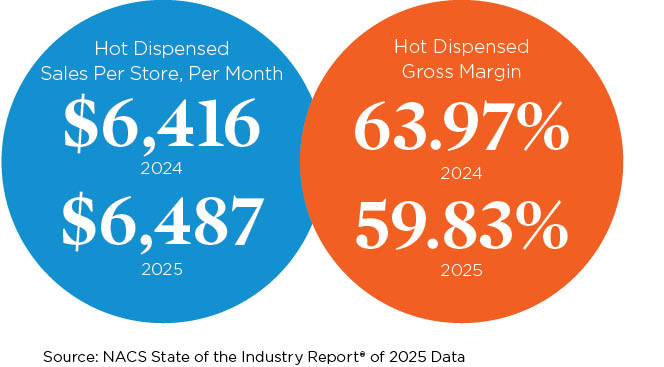
Last year was a challenge for the hot dispensed beverages category. As a percentage of foodservice sales, hot dispensed beverages were flat in 2025 at 8.5%, according to the NACS State of the Industry Report® of 2025 Data. The real news was in the commodity cost of coffee, which ate into margins.
Gross profit from hot dispensed beverages declined by 5.4% in 2025 to $3,881 per store, per month, the result of gross margin decreasing by 4.14 points in 2025, down to 59.83%.Lower-than-expected harvests in some coffee-growing regions, tariffs on imports and creeping inflation all contributed to declines in sales, gross profit and gross margin for the largest of the subcategories in 2025: coffee, which represented nearly 67% of hot dispensed beverage sales.
Coffee, when combined with the second-largest subcategory of cappuccino and specialty coffee, which represented 22.3% of hot dispensed beverage sales in 2025, represented most (89%) of the category’s sales.
Most hot dispensed sales (66.36%) take place during the breakfast hours, between 5 a.m. and 9 a.m.
Hot dispensed sales in c-stores peak between 7 a.m. and 8 a.m., a time period that accounts for 18.7% of all hot beverage sales. The morning hours drive sales of hot dispensed beverages as the return to in-office work continues and remote work becomes increasingly less common.
Catering To Customization
“Maybe 20 years ago, customers were only going to a convenience store to get gas and maybe go inside and get some coffee, but it was black coffee,” said Javier Carro, senior product manager for coffee and beverages at McLane. “Now with coffee shops launching so much innovation, convenience stores are following that trend.”
“Coffee has become a daily ritual and affordable indulgence,” said Gage Johnston, marketing manager for Franke Coffee Systems, Americas. “Today’s consumers are looking for personalization. They want to customize beverages with flavors, protein options, sweeteners, flavored creamers and toppings while maintaining speed and consistency. At the same time, customers still expect the classics.”
One way to provide a first-class experience is to give consumers more control over their drink order, according to Kathleen Timperman, chief science and innovation officer for Finlays Solutions. “For coffee, that means the ability to choose a grind type and beans that suit their flavor preferences,” she said, noting that bean-to-cup machines enable personalization, freshness and all-day availability.
Consumers Crave LTOs
When planning for LTOs and rotating seasonal flavors, Circle K listens to customers and solicits their feedback.
“This helps us deliver the unique experiences our customers expect when they visit our stores,” said Shawn Barnes, head of dispensed beverages for Circle K North America. “We’re always looking for ways to tailor and broaden the coffee bar for our customers who rely on us to deliver café-quality beverages in our stores. We’ll continue listening to customers and testing and innovating, including through our partnerships.”
While classic flavors still anchor the menu, “consumers are increasingly craving novelty and experience,” said Kyle Newkirk, chief commercial officer at Westrock Coffee. “And textural elements—cold foam, popping pearls, layered builds—are reshaping what younger consumers expect from a beverage altogether. It’s no longer just about taste; it’s about the full sensory experience.”
Although coffee gets the most attention in the hot beverage department, tea and hot chocolate deserve consideration as well.
“Tea is evolving on two fronts simultaneously,” said Newkirk. “It has great functional benefits and carries a health halo, with green tea and black tea still the leading SKUs. But low and no-caffeine options are uniquely positioned to serve the wellness needs of younger consumers, who seek beverages that reduce stress and support mental well-being.
“The opportunity is for c-stores to give hot tea the credit it deserves as a functional, intentional choice rather than just a commodity item, while building a cold dispensed platform that includes functional teas and refreshers that resonate with younger consumers,” Newkirk said.
Finlays Solutions reports that consumers are enthusiastic about elevated classics, a trend that uses various flavors to introduce subtle differences in familiar beverage territory.
“A familiar baseline is tea with lemon, but you can use lime instead,” said Timperman. “Botanical and fruit-forward flavors like raspberry, blueberry and others can be layered into hot tea and hot chocolate to create richer, slightly more complex flavor experiences.”
As for hot chocolate, it always gets a strong lift during colder months, but experts say it’s no longer just a seasonal drink.
“Consumers view premium chocolate beverages as year-round treats. Flavored hot chocolates, specialty toppings and indulgent beverages have helped expand its appeal beyond winter,” said Johnston. “Beverage programs should no longer be built around coffee alone. Consumers increasingly expect choice, customization and quality across coffee, tea and chocolate offerings. Operators that deliver all three effectively can create a more compelling destination and drive incremental beverage sales throughout the day.”
Timperman believes beverage programs can get creative by providing both dark and white chocolate options and serving drinking chocolate over ice or in blended frozen drinks.
“C-stores have evolved from quick stops into lifestyle destinations,” said Timperman. “The convenience stores experiencing strong growth in hot beverages are those that have moved beyond the one-size-fits-all model for dispensed beverages.”