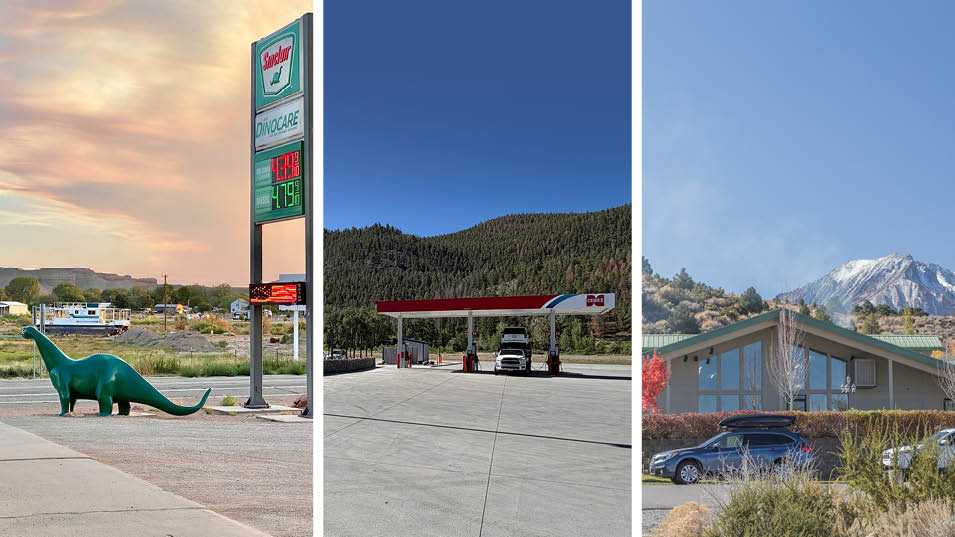
For some, it’s about creating something unique. For others, it’s exploiting the surroundings that make a location unexpected. Either way, retailers who do business in out-of-the-way locations or unusual circumstances are finding ways to create a point of differentiation and even make themselves a destination.
Here’s a look at three independent convenience store retailers that stand out as much for their business strategies as where they are located.
Inside Hollow Mountain
At Hollow Mountain, the first surprise is not what is on the shelves. It is where the shelves are.
Drivers rolling through Hanksville, Utah, a tiny desert crossroads of roughly 155 people, find the store at the junction of State Routes 24 and 95, where the extended miles of red rock country begin to feel especially long. The sign promises the usual roadside comforts: gasoline, diesel, cold drinks, snacks, souvenirs, maps and restrooms.
But when customers step through the glass doors, they walk straight into what used to be solid rock.
“It’s carved into a rock layer,” said owner Don Lusko, who has spent about 30 years working in the place locals and road-trippers know as Hollow Mountain. “You’re walking into a cliff face.”
In 1984, the original owner, Harry Thompson, and a business partner saw thick weekend traffic headed toward nearby (relatively, it’s still a four-hour drive) Lake Powell and wanted to put a gas station on the corner.
There was just one problem: A giant rock sat where the business needed to be. Hanksville, Lusko said, had little available land because it is hemmed in by federal property. So Thompson did what made sense in uranium country: He hired uranium miners to blast a hole in the rock.
They blasted out a tunnel, furred out walls, added sheetrock and utilities, and opened on Memorial Day weekend. The price tag was about $75,000. And it was worth it; according to Lusko, the store paid for itself that first weekend.
Hollow Mountain has the odd charm of a tourist attraction and the practical urgency of a lifeline. Atlas Obscura described it as an oasis in the desert with fuel, a restroom and snacks in climate-controlled air after miles of high-desert bentonite clay ridges and isolated sandstone monoliths. But Lusko is quick to say the store’s real advantage is simpler than novelty.
“We are situated exactly where somebody needs gas and a bathroom,” he said. “We don’t really need to advertise.”
Inside, most of the store looks like a regular convenience stop. The sales floor is about 3,500 square feet, Lusko estimates, though he has never measured it. There is a side tunnel used for storage. It’s what remains from a 2007 plan to add a Subway sandwich shop before the housing crash drained cash flow. In the restrooms, the rock is left bare, allowing customers to touch and admire the sandstone, one cool palmful at a time, making clear the building is not merely decorated like a cave. It is one.
Lusko came to the business sideways. He knew Thompson through rural Utah’s overlapping circles, worked as Hollow Mountain’s bookkeeper and helped expand the store in 2000. Thompson complained there was not enough room. Lusko had “a little explosive experience,” and Thompson was an old uranium miner, so the two chipped away at the rock and put in larger restrooms. When Thompson later wanted out, Lusko took over in 2004 with a handshake, followed by 20 years of payments.
Since then, he’s seen a change in the store traffic, though tourism remains the lifeblood of the location. In its early days, Hollow Mountain rode the boat traffic to Lake Powell. “Everybody had a boat,” Lusko said. “It was freeway traffic thick with boats.” The housing crash and more recent issues facing Colorado River water levels thinned the boat traffic over time. Today, motorists are more often bound for the numerous national parks in the region. “We’re like a pit stop in between Arches, Capitol Reef, Bryce and Zion.”
Still, summer provides a reliable rush. Warm weather can start the season early, as it did this year in March, but Hollow Mountain typically counts on Memorial Day through Labor Day to pay the bills. The town of Hanksville is well-suited for a short, intense burst of tourism: one motel, a handful of restaurants, some cabins, and not much else. Lusko stays open year-round anyway. “When you shut machines off, they sometimes don’t like to start back up,” he said.
With 12 fueling positions and only three employees (including Lusko and his wife), Lusko finds operating the store requires thinking like a businessman, mechanic, electrician, clerk and desert survivor. Repair people are expensive to summon. Something like a broken front door is exorbitant because of the cost of getting a glass shop to make the trip to Hanksville, Lusko said, so he fixes what he can himself.
And with a store that sits at the end of a long power line that runs through protected parkland, even electricity requires backup plans. “Our power goes out all the time,” he said. “So we have backup generators and all sorts of pre-preparation for disastrous situations, so to speak.” In a place built by blasting into stone, resilience is part of the floor plan.
That may be the real story of Hollow Mountain. It is quirky enough to get photographed and shared online by those passing through, and it’s also useful enough to matter. It is a souvenir stop, a fuel stop, a restroom stop and a strange little monument to making-do. The mountain was in the way, so someone hollowed it out. Four decades later, travelers still pull in from the desert, step through a door in the rock, and find exactly what they need.
Reaching Basecamp
Scenic South Fork, Colorado, is known as the eastern gateway to the Great Continental Divide, a place where Highway 160 bends toward Wolf Creek Pass and the San Juan Mountains rise in every direction. It’s there that Ross McKinney and a partner chose to build Basecamp Convenience, a location very specifically designed for specific groups of customers: yes, the about 500 local residents, but even moreso, truckers, skiers, RV travelers, hikers and families headed into the nearby Rio Grande National Forest.
McKinney operates seven other c-stores—but they are in Kansas, more than 600 miles away. The rural site earned his buy in based on trust in former employee Aricca Wallace, who helped McKinney see the promise in the out-of-the way location and who is McKinney’s partner in Basecamp.
“She used to be our office manager 20 years ago,” he said. “[She and her husband] have a second home in South Fork, and they just felt like it was a great opportunity, that the community needed a newer, bigger, more up-to-date convenience store. [It] was on Aricca’s recommendation that we came to check out the town, which is very small. It’s just the intersection of two highways, but we saw the opportunity so we moved forward.”
McKinney, partner and owner at Basecamp Convenience, also has a hand in operating Dara’s Corner Markets in and around Manhattan, Kansas. But South Fork was not another neighborhood store. It was a nine-and-a-half-hour leap west into a high-altitude, highway-dependent market where success would depend less on nearby rooftops and more on visibility, access, seasonality and the ability to become a trusted last stop before the pass.
“Most of our locations in Kansas are more located in or around neighborhoods,” McKinney said. “This site is very much dependent on highway traffic.”
As a result, the location demanded a different kind of store. Basecamp sits on a 4.5-acre lot. The building is larger than Dara sites, as well, at roughly 8,500 square feet. On the forecourt: 12 gas pumps, two dog parks (bigger dogs get their own space) and an outdoor patio that allows customers to enjoy a view of the mountains while they eat. In the rear, a separate diesel canopy and expanded parking await long-haul truck drivers. That detail matters in a mountain corridor often closed by weather and where drivers need a safe place to wait it out. Inside are many of the traditional c-store products, plus the Mountaintop Gifts & Gear retail area managed by local resort Tiny Timbers.
The “Basecamp” name is more than branding. It reflects where the store sits and who it serves. The Town of South Fork promotes itself as a basecamp for outdoor recreation, surrounded by vast national forest and year-round activities, including fishing, hiking, skiing, rafting, ATV riding and camping. McKinney said the store builds on the traditional convenience offer with fresh-made foodservice, freeze-dried hiking meals, RV and camper accessories, and trucker supplies.
Foodservice includes smoothies, bakery, sandwiches and pizza. “[Fresh food] is definitely our largest category department for inside sales,” McKinney said.
Fuel partner CHS Inc./Cenex calls Basecamp a shining example of the variety of one-of-a-kind independent retailers that the farmer-owned cooperative and fuel distributor serves in the United States.
“For a store like Basecamp Convenience in South Fork, Colorado, the role of the convenience store goes beyond fuel,” said Gary Braaten, director of retail development for CHS Inc. “It serves local residents, seasonal visitors and travelers heading into the surrounding outdoor recreation areas. Cenex supports retailers in these environments with high-quality fuels, brand recognition and programs designed to help them strengthen their operations, enhance their visibility and continue serving their communities in a meaningful way.”
Basecamp opened for business in July 2025. McKinney said the first year of business was “good” and that sales this past winter were “better than expected.” But he expects results to grow nicely in year two thanks to improved access from Highway 160. “The highway access opened up,” he said in late June. “That process has taken quite a long time from December 2024 up until yesterday to finally get the construction finalized and traffic opened up.”
Before then, customers had to exit a block away and loop around behind the store—hardly ideal for a retailer whose business model depends on easy entry and exit. With direct highway access now open, the owners expect stronger traffic and sales.
Still, seasonality remains one of the location’s core challenges. A remote store must be ready for summer crowds, for winter ski traffic and for holiday spikes, when appropriate. It also has to manage labor, inventory and operating costs during slower months. At Basecamp, employees are mostly from the local area, McKinney said, with some traveling as much as 45 minutes from nearby towns.
That unusual mix creates complexity and also resilience. A store built only for tourists might struggle in winter. A store built only for locals might miss the highway opportunity. Basecamp’s bet is that South Fork needs both: a polished convenience store for the community and a mountain-road hub for those passing through.
The Edge of Yosemite
Tioga Gas Mart and its Whoa Nellie Deli in Lee Vining, California, will celebrate its 30th anniversary this year. Started as a simple fueling stop with gas station food near the eastern entrance to Yosemite National Park, Tioga Gas Mart has spent the past three decades developing into a gift shop, a culinary destination, a live-entertainment venue and more. That unexpected mix in a remote part of the country has become a draw for travelers.
The setting explains the appeal. Lee Vining is a tiny community of only a few hundred residents. It’s tucked between the Sierra Nevada and the strange blue expanse of Mono Lake. It is the kind of town where the landscape does much of the marketing: tufa towers rise from the lake, aspens color the canyon in fall, and Highway 120 climbs west toward Tioga Pass and Yosemite’s high country. For much of the year, Lee Vining feels quiet. In summer, it becomes a funnel for campers, hikers, park visitors and road-trippers moving between the desert, the mountains and the national park.
And the food stands on its own two feet. Online publication Eater San Francisco called the deli “a culinary gem steps from the pump,” and online reviews tend to circle back to the same discovery: Travelers arrive expecting a utilitarian roadside stop and instead find fish tacos, buffalo meatloaf, breakfast burritos and outdoor seating with views of nearby Mono Lake. Tioga’s Gas Mart’s webpage now leans into that reputation, promoting “fuel, food and famous views.”
“We are a family owned and operated store since 1996,” said Denise Molnar, co-owner of Tioga Gas Mart and Whoa Nellie Deli, which was opened by her parents. Molnar can recall helping build the store shelves as the store readied to open, very much a DIY project. Over the years, the store has become a roadside hybrid: convenience store, gift shop, restaurant, camping supply stop and informal welcome center for visitors moving through the Eastern Sierra. “We’ve evolved over the years to accommodate our clientele in the best possible way,” Molnar said.
That clientele is unusually broad. Some customers are international tourists bound for Yosemite. Others are campers who need a forgotten item, road-trippers looking for fuel, or families lingering over lunch before or after going through Tioga Pass five miles to the east. “Our large selection of items caters to the many different travelers that come to our store,” Molnar said.
Tioga Gas Mart does not get a full year to make its model work, as snow and inclement weather force the road closed each winter. “We are a seasonal business, so we stay open from end of April to early November,” Molnar said. This year, the store opened for the season on April 25. Business builds as the weather improves. “[It] really ramps up when Tioga Pass opens, which depends on the amount of snow received during the winter,” she said.
For a store at the edge of a national park travel corridor, summer is not just busy; it means an almost constant flow of traffic. And it ramps up quickly, as if the starter gun has been shot at the beginning of a race. “Once schools get out, we go into full summer mode with huge summer crowds,” Molnar said.
Preparation starts before those crowds arrive. The team orders pallets of water, tracks best sellers and stocks custom souvenirs—T-shirts, water bottles, mugs and stickers—that can take weeks to produce. In a business where winter can close the doors and summer can fill the parking lot, the season is everything: Forecast carefully, stock deeply and be ready the moment the pass says go.