This interview is brought to you by Xcaliber International, a NACS Hunter Club member.
Sales of fourth-tier cigarettes grew slightly between 2024 and 2025, despite a softening of cigarette sales in general. What’s driving this growth?
Joe Nicolaus: Money. People have less of it. I could give you a longer answer, but that’s the engine under everything. A premium pack gets more expensive every year, and at some point, the smoker standing at the counter does the math.
What’s changed is what happens after they switch. People try a fourth-tier cigarette, they like it and they keep buying them. The quality caught up years ago. The perception is just now catching up to the quality.
NACS’s own State of the Industry data backs this up, too. Fourth tier grew sales in 2024 while most of the category shrank, and 2025 told the same story.
So far, 2026 is more of the same, only faster. First-quarter industry data has the discount segment at a record share of the U.S. market.
We’ve seen a rise in polyusage—how do fourth-tier cigarettes factor into an evolving backbar strategy?
Nicolaus: The polyuser is splitting their nicotine budget, so the cigarette slice of that budget shrinks. Fourth-tier gives that customer a way to keep buying cigarettes at your store on the budget they actually have.
I’d also tell retailers to quit worrying about pouches stealing space from cigarettes. Let the pouches earn their margin and let fourth-tier protect the cigarette trip, because cigarettes still pull a lot of people through your door.
Xcaliber is celebrating its 25th anniversary this year. What lessons can the company share with convenience retailers?
Nicolaus: Twenty-five years teaches you plenty, mostly the hard way. The big lesson is that value never goes out of style.
We sold cigarettes through the 2008 recession and through a pandemic. The value segment grew both times and it’s growing right now. Retailers who treat fourth-tier like a temporary guest in their backbar leave money on the counter. Every time.
Looking to the future, what should retailers expect from fourth-tier in the next few years?
Nicolaus: Expect us to keep taking share. Every premium price increase is a billboard for our segment.
Regulation is the other thing coming. Testing requirements keep expanding, and that will weed out suppliers who can’t keep up. If I ran a store, I’d be asking every fourth-tier supplier some hard questions about compliance before handing over shelf space.
What should convenience operators know about Xcaliber’s laboratory?
Dr. Jesse Phillips: Xcaliber’s laboratory is accredited to ISO/IEC 17025, the international standard for laboratory competence. Our methods, training, records, instruments, quality controls and reporting practices are independently evaluated. We have to continue demonstrating that the laboratory is operating properly to maintain that accreditation.
What I would want convenience operators to understand is that the laboratory is directly involved in the products that they are selling. We perform testing that supports product quality, manufacturing consistency and regulatory requirements. We do that work in-house. Because the laboratory is part of the operation, we can communicate directly rather than waiting on results from a third party that may have very little understanding of our process.
The laboratory gives us objective data about what is happening in production and allows us to act on that information. Most customers will never see the testing behind the product. They will notice if the product is not consistent. A large part of our job is making sure that does not happen.
How does Xcaliber’s product manufacturing affect the product that ends up in convenience stores?
Phillips: Xcaliber operates from a manufacturing complex of approximately 500,000 square feet in Pryor, Oklahoma. Leaf Forge, a new tobacco-processing facility of approximately 250,000 square feet, is located directly next to the Xcaliber operation.
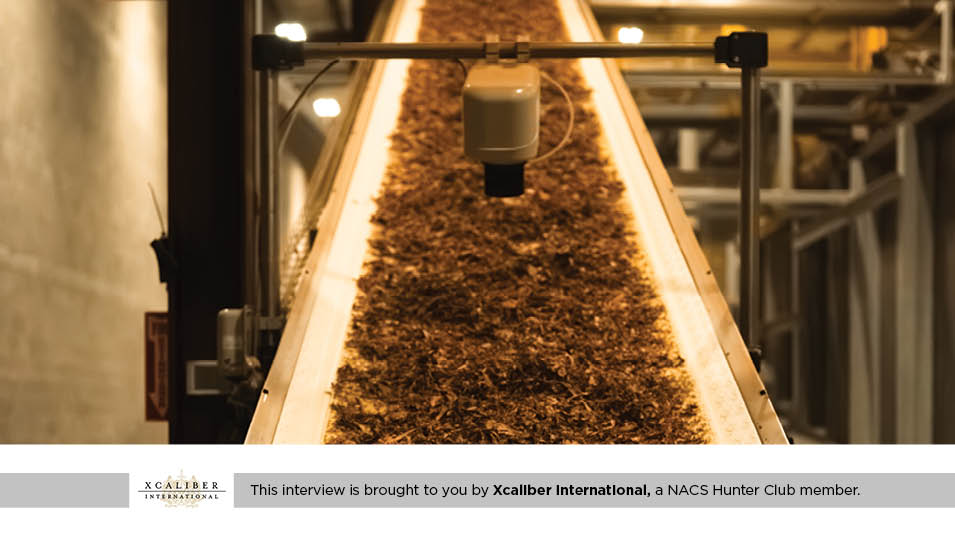
The proximity of the two facilities is important because it gives us more involvement in the tobacco before it reaches the finished-product manufacturing process. We can define the specifications we need, evaluate the processed tobacco against those specifications and communicate directly.
Tobacco is an agricultural material, so how it is processed, stored and handled can affect the characteristics and, ultimately, the consistency of the finished product. The proximity of the facilities reduces the transportation, storage and handling that would normally occur between a tobacco-processing facility and a manufacturing plant.
The result is a product made through a process with a high degree of internal oversight. The customer standing at the counter may not know how the tobacco was processed, how it was tested or how many people were involved in reviewing it—they simply expect the product they purchase today to be consistent with the one they purchased before. Our manufacturing and laboratory operations are built around providing that product.