Veteran retail tech manager Bill Wade can count on one hand the number of truly game-changing point of sale innovations.
“When I came aboard, the two biggest technology disruptors were pay-at-the-pump and barcode scanning at the front counter,” said Wade, a more than 35-year manager at PDI Technologies.
Around the time he joined PDI in the late 1980s, self-checkout was slowly finding its way into stores with mixed results. Since then, developments in point of sale (POS) have been “a lot of going over the same ground again and again and again. And sometimes it feels like you’re just grinding things into finer and finer and finer pieces,” Wade said.
“But that’s because we’re solving a lot of the same problems through multiple generations of technology,” he continued. “We’re still having to address those same issues because we still live in what amounts to Dodge City on a Saturday night from a data-security perspective.”
That’s where suppliers find themselves even now, as artificial intelligence becomes a new base on which to build overarching retail tech, with POS at its core.
“The POS is the hub of everything that’s going on at a site,” said Scott Negley, senior director of product management at Dover Fueling Solutions (DFS). “It controls the forecourt, the back office, the in-store transactions, the overall business flow. ... What we’re seeing now from [retailers is] they want to be able to do things with a little bit more flexibility, with a little bit more control and speed.”
Here’s a look at what is driving POS innovation forward today—and what’s slowing down potential generational changes.
The Holdback: Consumer Habits
Amazon, the second-largest retailer in the United States, announced in January the closure of its Amazon Go and Amazon Fresh stores, which were built on innovating the point of sale.
“Limited customer adoption.” That’s the reason an Amazon spokesperson cited for discontinuing its palm reader technology, but it could apply to the entire brick-and-mortar experience.
Frank Beard, head of marketing at Rovertown, said that the “ain’t never gonna” attitude is a frequent hurdle to overcome when introducing new technology, particularly when innovation overreaches or fails to adequately explain the how and why of a change.
“You’ll see a company come out with something and claim everything is different. ... They’ll deploy something that’s cool, but it just fizzles out. It doesn’t get adopted,” said Beard. “And oftentimes, it’s because it asks too much of that consumer to change their habits. Consumer habits do change over time, but they change slowly over time.”
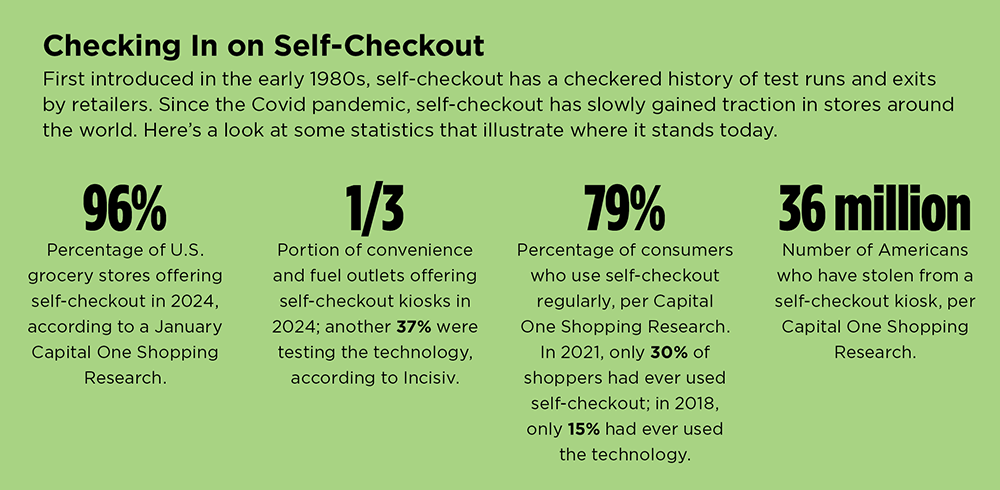
Beard believes that’s what slowed down acceptance of self-checkout for so long. “It’s basically the best new technology of the 1980s,” he said. “It’s old tech. It’s basically turning the register around and saying, ‘You do it.’ But it’s only in the past five years that self-checkout has really seen mainstream adoption.”
“And it took a pandemic to do it,” added Tyler Cameron, a former retailer and current head of strategy and analytics at Rovertown.
Autonomous checkout in the United States seems to be following a similar arch: super cool from the retailer point of view, but maybe too much tech too soon for consumers.
“That doesn’t mean the vendor didn’t do a good job with [the technology],” Cameron said. “The customer just wasn’t ready for it.”
Pay-by-Phone Grows More Important
As Cameron noted, the Covid pandemic, as disruptive as it was, deserves credit for accelerating many of the retail tech innovations in the past half decade. And it’s not just self-checkout; it’s mobile ordering, mobile payment, delivery and loyalty apps.
The history of mobile payment goes back to early experiments in the late 1990s. But it wasn’t until Starbucks added mobile payment capabilities to its loyalty app in 2011 that consumers began taking notice. The launch of Apple Pay in 2014 brought a new level of adoption for contactless payments.
Today, more than 55% of eligible users—those with a cellphone and payment method—have used mobile payment, according to Auriemma Group, a New York-based consultancy to the consumer payments and lending industries.
And there’s room for growth, according to Beard, comparing U.S. adoption of pay-by-phone to that in China. There, more than 80% of smartphone users rely on payment services Alipay and WeChat Pay to make purchases.
“Of course, those were helped along by government intervention, but it illustrates the room for growth,” Beard said. In the United States, PayPal leads the market with 36% of users preferring it over other digital wallets, according to the IPC.
With agentic AI on the rise, there’s a future where the phone plays a much bigger role. Imagine telling your phone that you need a bagel and a coffee, and the phone places the order (tapping into your loyalty programs and coupons) and manages delivery.
Such a fully-integrated system would be a great experience for a customer, Cameron said, “but there are a lot of real-world hurdles—such as laws—that would have to change.”
And its retailers’ general willingness to adapt and a desire to overcome these hurdles that keeps the convenience channel relevant, according to Wade.
“It’s been said that our channel is recession-proof. I don’t attribute that entirely to gas, cokes and smokes … and the fact that these are products that stay in high demand,” he said. “It’s also because of the adaptability of the people in this industry.”
The Future Is in the Cloud
Outside of a POS system that incorporates all of a c-store’s operating technology into a single cohesive network, the overwhelming request from most retailers today is a system that operates in the cloud.
“There’s been a really big shift to cloud-based POS,” Rovertown’s Cameron said. “I think of it as the untethering of the cash register. It used to be this huge bulky thing that had to live on a countertop somewhere, and now that it’s cloud-based, it doesn’t have to be. It can be on a phone. It can be on a small tablet. It can be in a number of places, and I think that untethering is the big innovation over the past few years.”
And there’s more to come, according to POS Nation’s “5 Convenience Store Trends To Help You Thrive in 2025” report.
“Gone are the days of juggling separate inventory, payroll and reporting tools. One behind-the-scenes convenience store trend is switching to a centralized system that handles sales, staffing and ordering into a single dashboard, giving owners real-time visibility into daily operations,” noted the report.
“That’s the way POS is going to go,” Wade agreed. “We’re centralizing the business logic in a way that allows us to deploy technology at the point of interaction.”
DFS' Negley said the “significant push” toward virtualization will speed this centralization. “Retailers are asking how they can become less reliant on hardware, on-premise-type devices,” he said.
That’s one of the reasons DFS, a longtime provider of fuel dispensers, got back into the POS business with its 2024 acquisition of Toronto-based Bulloch, a leading supplier of POS and related digital solutions for the convenience retail industry in Canada.
“We’re very excited to be able to do things that maybe we couldn’t before. [We now have] the opportunity to control the entire forecourt transaction from the point-of-sale out to the dispensers,” said Negley.
This consolidation of entry points will increasingly allow retailers easier access to manage pricing, transaction data, loyalty and marketing campaigns.
“That’s what we’re seeing,” Negley said. “[Retailers are asking]: How do I make sure I can sync two applications or two platforms [to] deploy a campaign faster, with more control and more reliability?”
Regardless of retailers’ desire, Cameron again comes back to the idea that any successful innovation must have the consumer in mind. “The [innovations] that have worked well were the ones that complemented the way customers shopped—they didn’t ask the customer to change too much.”
Ready for Revolution?
So when will the next great POS update happen? It’s happening right now, in real time, and at all times.
And it’s a good thing. Budget-wise, adopting a new POS system is a costly affair. Realistically, a retailer isn’t going to make that investment more than once or twice a decade.
Still, 25% of retailers plan to upgrade their POS system in the next two years, according to a retailer survey conducted by Dover Fueling Solutions in partnership with NACS Research. And with artificial intelligence accelerating the pace of innovation, the challenge for retailers is deciding whether a solution can be as simple as hanging a new app on the existing tech stack or if it needs to invest in a completely new system.
“You don’t want a system that’s going to be a white elephant in two or three years,” Negley said. “There’s a lot to consider: Does it support a virtual, containerized solution? Will you be able to update as needed?”
Those were among the goals for Tennessee-based Weigel’s when it invested in the new NCR Voyix Edge system in 2024.
Faced with hardware reliability issues, slow loyalty transaction speeds and the challenge of integrating new technologies, Weigel’s sought a “hardware agnostic” virtualized POS systems, according to supplier NCR Voyix.
“NCR Voyix Edge’s agile infrastructure and hardware-agnostic approach enabled us to run their latest POS software on our existing Verifone hardware, delivering enhanced resilience and the agility to elevate the customer experience,” said Michael Bee, director of IT, Weigel’s. As a result, “Loyalty transactions are easily 40% faster.”
Huck’s Market, which has 135 locations across the Midwest, deployed Tote’s AI point-of-sale platform at its flagship location in Carmi, Illinois, in early 2026, with plans for a rapid chain-wide rollout by the end of the year.
“Huck’s invests heavily in clean, modern store environments, and the old system didn’t reflect that. Managers noted the new POS is a clear departure from something that felt like it was from a past era,” said Murat Tokad, president and CEO of Martin & Bayley Inc., parent company of Huck’s Market.
Managers at Huck’s Market have reported that clearer transaction guidance, including improved visibility into EBT-eligible items, was a meaningful day-to-day improvement that reduces confusion for both staff and customers.
“Both the POS and self-checkout clearly display how much of a transaction is EBT-eligible, which cuts down on confusion at the register. Managers flagged this as one of several surprise-and-delight moments they’ve encountered so far,” Tokad said.
Fewer boutique applications. More cross-functionality. Ease of use. These are the things retailers want out of their point-of-sale systems today, and slowly, they’re getting it.
That’s the next great POS update.
The TruAge® Age-Verification Tool
As seen with some of Amazon’s latest closures, there’s risk in rolling out cool tech that asks too much of consumers in terms of changing their habits.
TruAge® is built around the opposite idea: Make age verification faster and safer while keeping checkout familiar. It’s a privacy-first, not-for-profit age-verification service created by NACS that verifies age instantly by scanning what customers already have—any valid U.S. driver’s license, a TruAge-enabled mobile driver’s license, or the TruAge app—then returning a simple yes/no result.
For retailers, TruAge reduces compliance risk and employee errors by capturing only the four data points required to verify age and converting them into a single encrypted, anonymized token—creating tamper-proof evidence that a check occurred without storing personal information. Built-in fraud detection can flag invalid IDs. Configurable lockouts/volume limits help prevent repeat attempts or restricted over-purchasing. A self-service portal provides 24/7, store-level reporting (carding rates, declines) so operators can spot training gaps early.
TruAge integrates directly into major POS platforms—including Verifone Commander, Invenco by GVR/Gilbarco Passport, NCR/GK (coming mid-2026), Clover, Pinnacle Affiniti, PlatformPOS and Minor Decliner, often with activation starting in under 24 hours and no new hardware required. Quick-start materials, training and in-store signage support rollout. For more information, visit mytruage.org.