A few years ago, I was in the green room at a television network, waiting to go on the air to talk about the latest hurricane that was going to strike the Gulf Coast and wreak havoc on the country’s petroleum infrastructure.
I got to talking with another guest who was waiting to go on for a different segment, but he was more interested in talking about mine—everyone loves talking about gas prices. He had a simple question for me: If we know that hurricanes strike the Gulf Coast, why don’t we just build out the infrastructure where hurricanes don’t go—like Minnesota?
Setting aside that the political climate in Minnesota might make it the last state to look to when it comes to building a robust petroleum infrastructure, the question wasn’t totally off base. Most people simply don’t know much about petroleum beyond the price at their corner store.
Of course, the reason that petroleum infrastructure is built out in the Gulf Coast is efficiency—a huge percentage of U.S. oil production is in that area. But the U.S. petroleum infrastructure is only part of a much larger ecosystem that has interconnected hubs around the world.
A new report developed by the Transportation Energy Institute (TEI), Global Petroleum-Based Fuel Markets: A Primer, provides some simple explanations on how transportation fuels move around the United States—and the world.
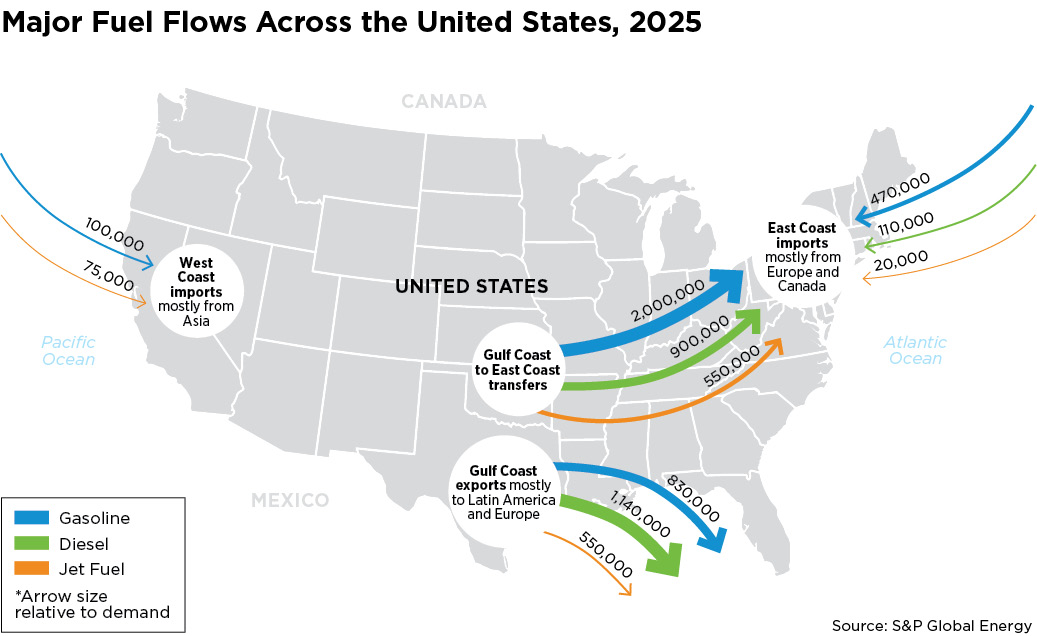
While the United States produces more gasoline, diesel and jet fuel than it consumes, that doesn’t mean that it is energy independent. Logistical and regulatory challenges complicate how fuel moves throughout the country, particularly on the East and West Coasts. As a result, those two regions reply on imports to satisfy demand. Meanwhile, excess U.S. production is shipped around the world.
The report highlights three major hurdles that force the need for imports on both coasts:
The Jones Act: This federal law mandates that shipping between U.S. ports must be done only by vessels that are U.S.-owned and operated. This requirement dramatically increases costs and makes it more cost-effective to acquire imported fuel. (In March 2026, the U.S. Department of Homeland Security issued a limited waiver of the Jones Act that is set to expire on November 15, unless it is renewed.)
Pipeline infrastructure: Pipelines are the most efficient method to transport fuel across the country, but the Rocky Mountains limit options to build pipelines that connect the West Coast to fuel elsewhere in the country. There also are limited connections to pipelines in both Florida and New England.
Boutique fuels: There are more than a dozen unique fuel specifications mandated across the country, and California’s specifications are among the most stringent; not all U.S. refiners are equipped to produce these more complex blends.
Because of these challenges, despite record U.S. oil production and refinery capacity, the country still requires fuel imports, particularly during peak demand over the summer months. Meanwhile, it exports fuel to Latin America and Europe.
This is just a snapshot of what is included in the report. Global Petroleum-Based Fuel Markets: A Primer goes into much more detail on the broader global fuels infrastructure.