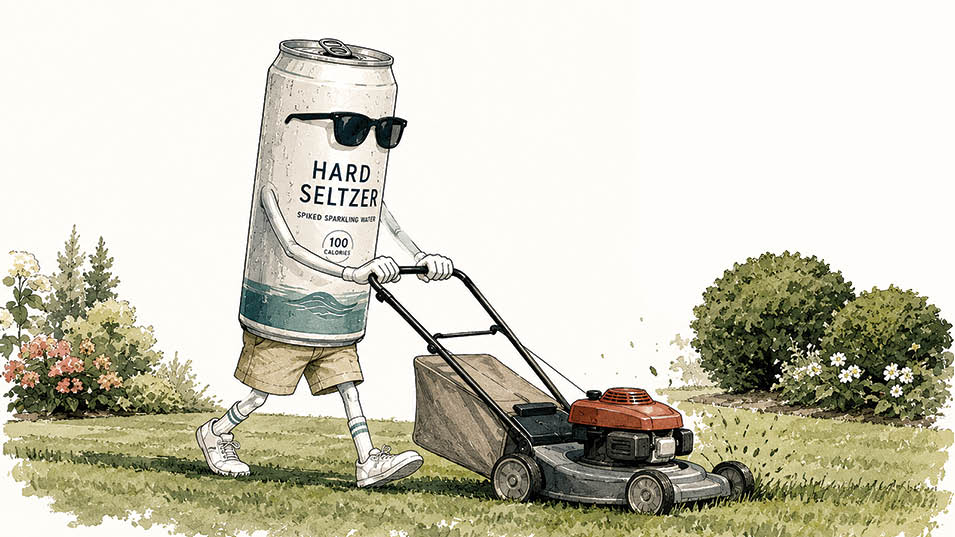
During the summer of 2019, Lil Nas X’s “Old Town Road” was inescapable. “Stranger Things” season 3 debuted on Netflix. The U.S. team won the FIFA Women’s World Cup. Covid wasn’t in anyone’s vocabulary yet. And seemingly every cooler at every backyard cookout in America was packed to the brim with White Claw.
It’s been seven years since the summer of “Ain’t no laws.” At the time, hard seltzer had just exploded onto the U.S. alcohol market and created an entirely new category that upended the beer aisle’s status quo. That year marked hard seltzer’s highest growth rate, but peak hard seltzer sales wouldn’t come until 2021, when brands reached full national penetration and even grandparents understood that hard seltzer existed. In 2019, hard seltzers made up 7% of total beverage alcohol dollars in the United States, according to data from market research company Circana.
Since then, much has been reported about hard seltzer’s softening, bubble bursting or fizz flattening. (It’s too bad the category name lends itself to such easy analogies.) We’ve seen the long tail of hard seltzer proliferate and then contract, and we’ve watched the inevitable swell of spirits-based versions competing with the original malt-based brands.
But don’t sound the death knell for traditional malt-based hard seltzer. Especially in convenience stores, it’s still a formidable category.
According to data through mid-May from Circana, malt-based hard seltzers are a much larger category than craft beer in convenience stores, contributing twice as many dollar sales as craft did during roughly the first half of the year. White Claw Black Cherry is a top 15 beer brand in convenience stores, and the brand’s variety pack cracks the top 20.
Seltzer’s long tail falling off has simplified the shelf and funneled drinkers toward reliable, high-volume brands. From a height of 353 brands on shelves in 2022, just 170 remain, according to data from research firm NIQ. The top six hard seltzer brands make up 98% of the segment, with the top two, White Claw and Truly, together holding 85%.
“The segment is here to stay,” said Ethan Peiffer, brand manager at wholesaler Origlio Beverage, which includes White Claw maker Mark Anthony Brands in its portfolio. “It’s built such a huge base that we don’t feel that it’s going anywhere.”
A Cooling Category With Pockets of Growth
That’s not to say hard seltzer hasn’t faced headwinds. In the latest 52 weeks, malt-based hard seltzer dollars declined by 5.7% compared with the previous year in NIQ off-premises channels, outpacing overall beer/malt declines of 3.6%. However, this rate is slower than the declines seen in previous years, according to analysis by Danelle Kosmal, a consultant with 3 Tier Beverages.
“The industry has been quick to write off seltzers after growth slowed rapidly and turned to declines after 2021,” Kosmal said.
“However, the segment remains relevant, accounting for nearly one-third of total ready-to-drink dollars across beer, wine and spirits.”
As the novelty of hard seltzer has faded, it has matured into a staple fourth-category alcohol beverage alternative to traditional beer, wine and spirits. Suppliers continue to introduce new flavors and packages to meet consumer demand. Because of its flavor neutrality, hard seltzer has proven itself a resilient shape-shifter, able to adjust in taste, carbonation and ABV to reflect current beverage trends. As drinkers increasingly chase flavor across all alcohol categories, hard seltzer remains synonymous with flavor-forward offerings.
Hard seltzer’s flexibility has helped it adapt to fast-changing consumer preferences, and some brands have grown in the process.
Brands including Molson Coors’ Topo Chico Hard Seltzer, Boston Beer’s Truly and White Claw have introduced higher-ABV lines, called Topo Chico Hard Margarita Max, Truly Unruly and White Claw Surge, respectively. Higher-strength seltzers of 7 to 9.9% ABV are the only segment of hard seltzer that’s growing, up 12.5% in the last 52 weeks, Kosmal said. Higher-ABV seltzers—primarily White Claw Surge and Truly Unruly—are gaining even more momentum in c-stores than across other retail channels, up 17.5% in convenience for the latest 52 weeks, outpacing sales in grocery. Their bolder flavor and elevated alcohol content provide a cocktail-like experience in a convenient, single-serve can.
New variety packs continue to be important in the highly flavor-driven hard seltzer space as well, with brands debuting new flavor combinations and cocktail-inspired packs to maintain consumer interest. Single-serve cans and even nonalcoholic versions meet drinkers where they are.
“[Hard seltzer] is a high-ring item for everybody. It’s a moneymaker that brings in a different clientele,” Peiffer said. “The end consumer found the brands they’re willing to spend their money on.”
Uniquely Adaptable Flavor and Relevance
As a superbly versatile liquid, hard seltzer is well positioned to respond to shifting drinker preferences and interests, in terms of both flavors and cultural tie-ins. Brands deliver flavors inspired by other well-loved beverages, such as Truly’s lemonade-inspired line, Bud Light’s hard-soda seltzer line (including flavors Cherry Cola and Orange Soda) and Lone River’s portfolio, a nod to the Texas-born ranch water cocktail. Berry, tropical and citrus remain perennial favorites, to be sure, but some brands have found other niches, such as spicy, botanical and dessert-inspired flavors.
Regional hard seltzer brands can lean into interesting flavors, too. For example, the Water Works line of hard seltzers produced by Missoula, Montana-based Draught Works Brewery includes a Mountain Berry flavor that nods to the state’s beloved huckleberries. California’s Crow & Wolf Brewing brings a tropical, confectionary vibe with flavors including dragonfruit, yuzu, vanilla sorbet and guava.
NIQ data indicates that shoppers tend to have lower levels of “category planning” when shopping for ready-to-drink (RTD) beverages compared with traditional beer, wine and spirits, suggesting RTD shoppers are more likely to make decisions at the shelf. Therefore, it’s important that retailers balance their assortment to include stalwart berry and citrus favorites while also including enough variety to satisfy the flavor-seeking customers who turn to hard seltzer and the broader RTD category for what’s next.
“Flavor is king,” Peiffer said. “Once people find the flavor they really enjoy, they tend to gravitate toward that, but variety packs are still a huge part of the business.”
Convenience store sales reflect both realities. Twelve-packs account for the highest sales (45%) of malt-based hard seltzer in c-stores, Kosmal said. However, singles are a very close second, accounting for 43% of seltzer dollars.
“For Truly, variety and exploration are key reasons drinkers choose the brand, so we want to focus on maintaining fan favorites while introducing new limited-time offerings that drive novelty and discovery,” said Taylor Jette, senior manager of communications for The Boston Beer Company.
Another plus for the segment: Unlike traditional alcohol categories, hard seltzer benefits from a lack of cultural baggage. Whereas red wine has long been tied to dining or rum to warm-weather cocktails, hard seltzer is young enough to reinvent itself in new cultural moments and appeal to a broad demographic of consumers.
“Beer marketers have been trying to crack the code of being gender-neutral after years of ignoring half the population. Big brewers haven’t really been able to do it, but then White Claw came in, and it’s always been a gender-neutral thing,” Harry Schuhmacher, editor and publisher of Beer Business Daily, told The Washington Post in 2019. (Data confirms that hard-seltzer drinkers are about evenly split between men and women, particularly in younger legal-drinking-age cohorts.)
Hard seltzer brands have also leaned into partnerships and promotions tied to major events that attract a multicultural audience. Both Topo Chico Hard Seltzer and Truly capitalized on the FIFA World Cup this year. Truly, acting as the official hard seltzer of U.S. Soccer, released a limited-edition Star Squad soccer-themed pack with flavors such as Baller Berry and Red, White & Tru, as well as a U.S. Soccer-branded 24-ounce can. Topo Chico released a new soccer-focused 15-second commercial, “Hello Extra Time,” which debuted in late May. Topo Chico was also one of the Molson Coors brands spotlighted in commercials on national and local TV; those ads ran in both English and Spanish and were broadcast during high-profile World Cup matches.
“The biggest drivers are clear: engaging promotions and strong in-store visibility. That includes eye-catching displays, promotional packaging and digital touchpoints like rebates and in-app offers,” Jette said. “Partnerships, like our U.S. Soccer 24-ounce collectible cans, help drive discovery before, during and after the shopping trip.”
Looking Ahead for Hard Seltzer
Though the seltzer category has matured, it’s certainly not static. Malt-based hard seltzers have yielded ground to spirits-based seltzers such as Gallo’s High Noon, Anheuser-Busch InBev’s NÜTRL, Suntory’s -196 and Stateside Vodka’s Surfside. In 2021, malt-based brands classified as beer made up 97% of total hard seltzer dollars; today, they make up about 74%, Kosmal said.
“The introduction of High Noon and other vodka-based seltzers, along with the rapid growth of spirits-based cocktails, reshaped the RTD landscape and expanded consumer choice beyond malt-based offerings,” Kosmal said. “At the same time, pandemic-related closures of bars, restaurants and social events further accelerated RTD adoption and growth. Spirits-based cocktails, in particular, benefited as drinkers sought convenient, bar-quality experiences at home.”
But spirits-based RTDs aren’t always a one-for-one swap for hard seltzers, particularly not in terms of retail availability. (Many states confine spirits-based RTDs to liquor stores, limiting their reach to consumers.) Spirits seltzers were flat in total off-premises channels but up 4.4% in c-stores, according to Kosmal’s analysis of the 52 weeks ending June 13.
Even within traditional malt-based seltzers, the category continues to morph. Leading brands have introduced higher- ABV and higher-flavor-intensity offshoots, keeping the core malt-based hard seltzer product synonymous with sessionable (low-alcohol) refreshment.
Truly has expanded its seltzers into three buckets: light flavor, high ABV and bold flavor.
White Claw has grown into cocktail territory with its Clawtails line of FMBs, higher ABVs with its Surge line and a non-alcoholic line called Zero Proof. Earlier this year, Topo Chico Hard Seltzer launched a line it defines as “flavored adult beverages,” still branded as Topo Chico Hard Seltzer but with less effervescence and more intense flavor. It also recently introduced glass bottle packages for both lines, supplementing the brand’s original slim cans.
“The Surge line has been a point of differentiation that’s bringing in more of the younger crowd,” Peiffer said. “It’s bringing people into the category, which is important, and then they’re branching out from there.”
Such innovations go to show that the boundaries of the hard seltzer category are still fluctuating, even as the segment matures. Core products and national brands will continue to define this space, but flavors, packaging, ABVs and regional plays aren’t remaining static. Despite headwinds— from spirits-based competitors and from general sluggishness in alcohol sales— malt-based hard seltzer has weathered the supposed bust, emerging as a staple category driving hundreds of millions in sales for convenience stores nationwide.