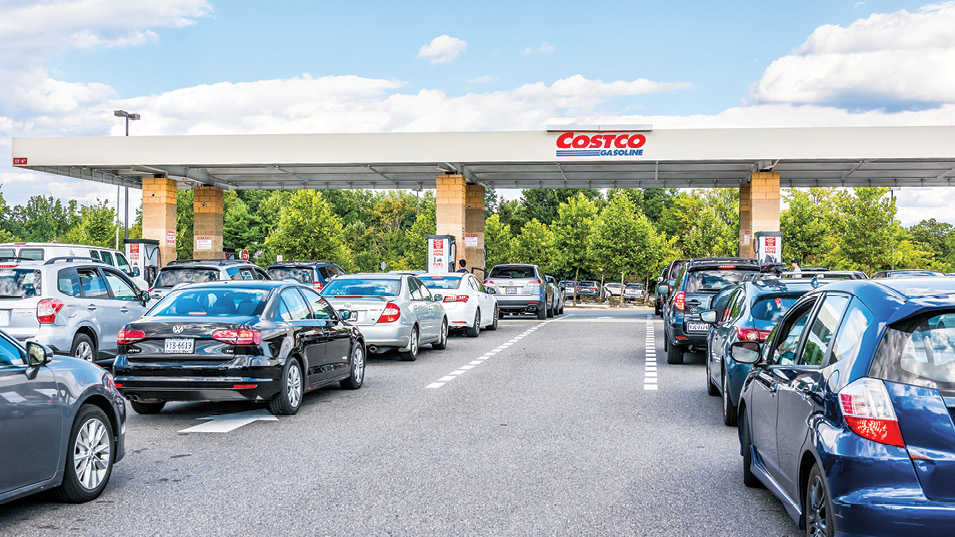
The need to refuel drives trips to convenience store forecourts—no surprises there. But what about going inside the store? Turns out, according to the 2026 NACS consumer survey, customers like to do both. Nearly two in three consumers (62%) say they went inside the last time they bought gas, with refueling being the main reason for their trip (72%).
These findings are in line with the 2025 NACS Convenience Voices program, which captures real-time insights from daily c-store shoppers while they are physically on-site at a convenience store: More than three quarters (76.2%) of refueling customers say they will go into the store on some of their visits, but not all.
Both surveys have significant value for understanding c-store shopper behaviors. For this article, and the subsequent four that will follow in future issues of NACS Magazine, we’re diving into the latest insights from this year’s NACS consumer survey.
Over the past 20 years, this survey has asked consumers about specific actions they take at convenience stores, including their journey to the store, on the forecourt and inside the store.
Who Is the Average Gas-Buying Customer?
Roughly three in four consumers (72%) are frequent customers, meaning they shop at a c-store at least monthly. Men are more likely than women to shop at a c-store at least multiple times per week (34% vs. 22%), which is the widest gap recorded in the survey’s 20-year history. One in 11 consumers say they visit a convenience store every day.
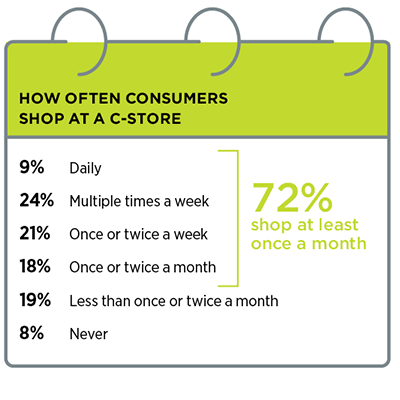
As mentioned, refueling is the main reason consumers come to the store. Frequent customers were the group most likely to cite a beverage purchase as the main reason for their visit (28%), while people ages 18 to 34 were the group most likely to seek out a store for a food purchase (40%). Most consumers who stop to refuel do so at least weekly (40%) or biweekly (28%).
Most consumers say they prefer to stop at convenience stores when they need to refuel (79%)—a drop of six percentage points from 2025.
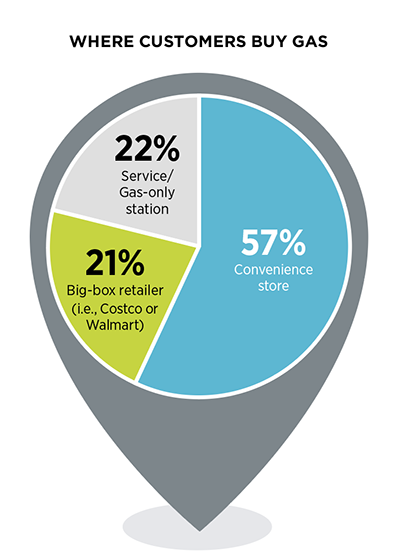 The most likely consumer subsets to purchase fuel from a big-box retailer are age 65 and older (38% of this cohort, a 16-point increase from last year) and those in the West (25%, a 3-point increase), a region that traditionally has the highest average gas prices in the United States.
Most Plans to Refuel Are PremediTated
Convenience stores are known for their immediate consumption items. About 80% of items purchased in a convenience store are consumed within the hour, according to NACS research.
But even though most purchases are addressing an immediate need—hunger, thirst or a low fuel tank—that doesn’t mean that the trip wasn’t planned. Increasingly, consumers are making their buying decisions not based on where they are on the road in relation to a convenient right-hand turn into a c-store, but well before that.
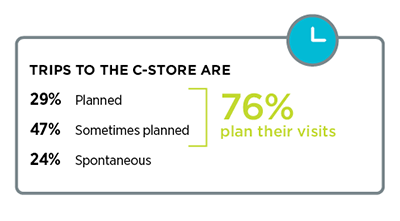
Overall, three in four consumers say that they plan out their c-store visits—the rest consider their stops “spontaneous,” which suggests they decided to stop when they saw a store on their route or an advertisement or offer that motivated them to stop.
Gas Price and ‘Deals’ Attract Customers
Although average gas prices nationwide began 2026 at a comparatively low $2.80—25 cents lower than 2025—customers will seek the best gas price they can find.
Talking to customers about prices and deals starts with your loyalty program. Among c-store loyalty program members, more than half (53%) say they are more likely to shop at a c-store because of its loyalty program. Women are slightly more likely than men to say they are more likely to shop at a c-store because they are a member of its loyalty program (55% vs. 51%), and those 18 to 34 years old are the cohort more likely to shop at the store (59%) because of a loyalty program.
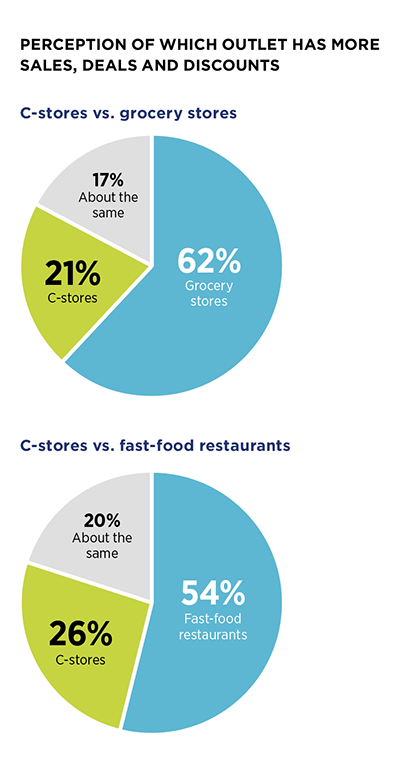
Only 16% of consumers say that they see sales, deals or discounts “very often” when shopping at convenience stores. And, they say that sales, deals and discounts are much more common in competing channels. Those who may be attuned to saving money, such as those age 65 or older, are least likely to say convenience stores offer deals.
Final Thoughts … for Now
Economic concerns are always top of mind with consumers. For c-stores, that puts the focus on overall value. Customers make buying decisions before they even get in the car, whether that’s for fuel or food. Retailers who win in this environment are the ones that best communicate their offer via their digital presence, whether online or via a loyalty app, to get customers onto the forecourt and inside the store.
Future coverage of this five-part series will look at how consumers define convenience, the conveniences they expect from c-stores, important elements of customer service and attitudes and actions related to food.
.jpg?language=en-US)