Nearly 75% of all restaurant orders aren’t eaten at restaurants—meaning about three out of four orders are consumed in a car, at home, at work or somewhere else, according to the National Restaurant Association’s 2025 Off-Premises Restaurant Trends report.
The findings highlight how off-premises dining has grown, “with the convenience and availability of takeout, delivery and drive-thru now deeply embedded in everyday life,” noted the report.
Convenience stores have long offered off-premises consumption by way of dashboard dining, with customers taking their food and drink purchases to go. The drive-thru, meanwhile, has been a relative newcomer to the c-store space.
Given the QSR industry’s drive-thru dominance, is there room in the sandbox for convenience stores to grow this type of service? The 2026 NACS consumer survey revealed what consumers think about less-common c-store offers like drive-thru, as well as delivery.
Drive-Thru vs. In-Store Habits: Hard to Break?
The key differentiator for drive-thrus is that consumers don’t need to leave their car. While speed of service is often cited as a top reason for choosing a QSR drive-thru, the math doesn’t add up.
Even the fastest QSR chain’s drive-thru is slower than the average c-store visit. Taco Bell has the shortest average drivethru time at about four and a half minutes, according to the 2025 QSR Drive-Thru Report. The average c-store visit takes about three and half to four minutes.
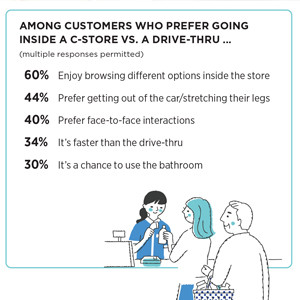
QSRs also can’t compete with c-stores on what’s inside the four walls. Unlike QSRs, convenience stores offer way more options, such as packaged beverages and center store merchandise like candy and snacks.
When asked to imagine that they were purchasing food and/or drinks from a c-store that had a drive-thru option, people had a slight preference for the in-store experience, with 38% saying they would go inside, 31% opting for the drive-thru and 25% having no preference.
Physical Shopping Rises Above Delivery
Proximity is a key part of the convenience store value proposition, with 93% of all Americans living with 10 minutes of a c-store. Considering all shopping occasions—not just those at convenience stores—consumers prefer to shop inside the store. While about half of all Americans don’t have a preference whether they go to the store or order online for delivery, those who have a preference said they prefer the in-store experience over online ordering by an almost two-to-one margin (32% vs. 18%).
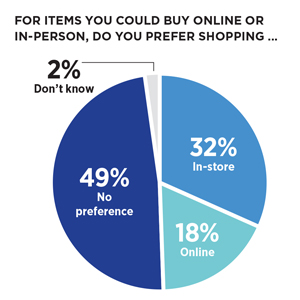
However, there are strong variations by age. Those ages 18-34 are most interested in online ordering over shopping in-store (28% vs. 13%). To a smaller extent, those ages 35-50 are also more interested in online ordering than the in-store experience (24% vs. 19%).
Whether in-person or online, convenience stores have a distinct advantage over all other retail: speed of service. Whether a consumer is hungry, thirsty or running low on gas, a right-hand turn to a c-store can solve those needs.
Given that convenience stores sell just that—convenience—it’s no surprise that frequent customers are also interested in delivery. While 62% of consumers report that they’ve used a food delivery service in the past, 84% of frequent c-store customers report doing so. The same pattern holds for grocery delivery, where 50% of consumers have tried a grocery delivery service but 70% of frequent c-store customers have done so.
When asked whether the items they purchased via a grocery delivery service could have been purchased in a c-store, only 18% of overall consumers said yes, while 78% said no.
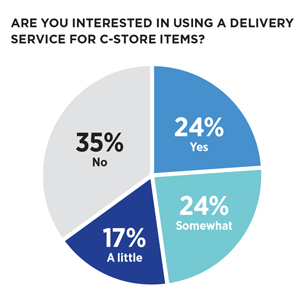
Overall, nearly half of all consumers (48%) are at least somewhat interested in using a delivery service for c-store items.
Age Gap: Different Consumers Have Different Needs
Whether a drive-thru and delivery is right for your business also depends on the customer base you want to attract. Younger customers aged 18-34, for example, are more likely to want household goods, basic electronics and fresh groceries at c-stores compared to customers aged 35-50, who gravitate toward traditional c-store offerings like fuel, restrooms and beer.
Why the difference in perceptions? Traditional retail channel definitions might not apply to younger consumers— especially those who have grown up in a world that’s always been online and convenient.
To attract those younger customers, it will continue to be important to define how you best fit into their lifestyles and can make their lives easy—especially competing in a retail environment that includes easy, ever-present delivery options.